
Should I Buy a New or Used Ferrari F8 Tributo?
The F8 Tributo is gone — production ended in 2022. But used examples are available now at $250K–$300K. Meanwhile, the new 296 GTB costs $320K+ and trades pure V8 soul for hybrid efficiency. Here's how to decide.
The Reality: You Can't Buy a New F8 Tributo
Let's start with the obvious: Ferrari discontinued the F8 Tributo in 2022. If you're reading this in 2026, there are no new F8s on Ferrari's order books. You're choosing between used F8 Tributo examples ($250,000–$300,000) and the brand-new 296 GTB ($320,000+), which is a fundamentally different car — hybrid V6 instead of twin-turbo V8, electric assistance instead of pure mechanical response, a step into Ferrari's electrified future instead of its naturally aspirated past.
The question isn't really "new or used F8." The question is: do you want the last of Ferrari's pure V8 mid-engine berlinettas, or are you ready to embrace the hybrid era? That's a choice with profound implications for your driving experience, your total cost of ownership, your car's future value, and what that purchase actually means philosophically — if you care about such things, which most Ferrari buyers do.
We've helped dozens of buyers navigate this exact decision at Automonitor. Here's what you need to know to make it intelligently.
Why the F8 Tributo Ended: And Why That Matters
The F8 Tributo wasn't killed because it was unpopular. It was killed because the world changed. European emissions regulations have become so strict that naturally aspirated engines are becoming impossible to justify — even in low-production supercars. Hybrid powertrains, though they add weight and complexity, allow manufacturers to offset their carbon footprint through electric-only driving capability and regenerative braking. The 296 GTB's hybrid system lets Ferrari claim it's a "responsible" supercar, which matters increasingly when your customers are subject to vehicle registration laws in places like California, Germany, and the UK.
Ferrari's reasoning is clear: the F8 represented the end of an era. The 296 GTB represents the beginning of the next one. Whether that's a good trade depends entirely on what you value in a supercar experience.
The F8 Tributo is the last Ferrari V8 berlinetta. Every year that passes makes it more historically significant — and more valuable to collectors who understand what's being lost.
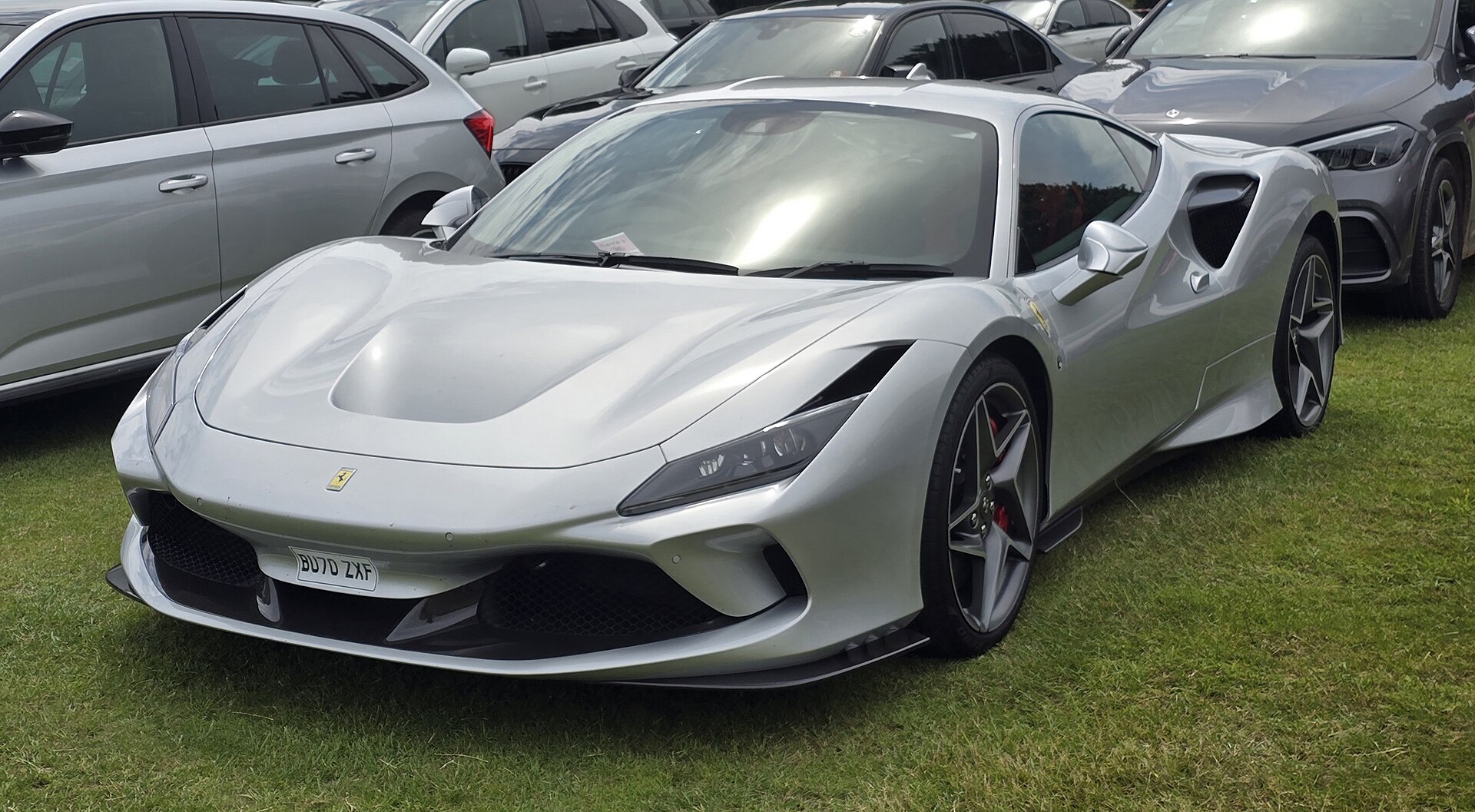
The F8 Tributo: What You're Actually Getting
The F8 Tributo was Ferrari's answer to the question: "What does a mid-engine, twin-turbo V8 berlinetta look like in the age of electrification?" The answer was unapologetic.
A 3.9-liter twin-turbocharged V8 engine sits behind the driver, producing 710 horsepower and 568 lb-ft of torque. There's no hybrid system, no electric motor supplement, no regenerative braking. The power comes from combustion alone. The 0–60 mph time is 2.9 seconds. Top speed is 211 mph. The transmission is a 7-speed dual-clutch automatic that shifts with mechanical precision and no electric intervention.
The F8's chassis is an aluminum space frame, the suspension is fully independent double-wishbone with adaptive damping, and the braking system uses carbon-ceramic discs. The steering is electric but not overly assisted — Ferrari spent considerable engineering effort making it feel connected and responsive despite the lack of mechanical linkage.
From a pure performance standpoint, the F8 Tributo is a complete Ferrari. 710 horsepower is genuinely significant. It out-accelerates nearly everything on the road. It will lap a race track faster than 99% of drivers can safely push it. But the real appeal isn't the numbers — it's the character that those numbers represent.
The 296 GTB: The Hybrid Successor
The 296 GTB is smaller, lighter, and more ambitious. Its 3.0-liter twin-turbo V6 produces 654 horsepower from combustion alone. Add the 163-horsepower electric motor mounted to the rear axle, and the combined output is 818 horsepower. Peak torque is 531 lb-ft from the engine plus 228 lb-ft from the electric motor, for a total of 759 lb-ft when both systems are working together.
The 296 GTB accelerates from 0–60 mph in 2.7 seconds — 0.2 seconds faster than the F8. Top speed is identical at 211 mph, but the hybrid system means the 296 GTB can run on electric power alone for up to 25 kilometers (about 15 miles) at low speeds, and the electric motor provides seamless torque fill-in between gear changes in its 8-speed DCT transmission.
The 296 GTB is lighter than the F8 by roughly 150 pounds, more aerodynamic, and features active rear-wheel steering that the F8 doesn't have. On a racetrack, the 296 GTB is objectively faster. On a road, the character difference is profound — and which character you prefer defines whether this choice even matters.

The Sound Factor: Why V8 vs V6 Matters More Than Horsepower
Here's what the spec sheets don't capture: a naturally aspirated V10, a V12, and a V8 all have frequency characteristics that resonate differently in your chest cavity. A turbocharged V6 — even one as well-engineered as the 296 GTB's — simply cannot produce the same sound.
The F8 Tributo's 3.9-liter twin-turbo V8 pulls to 7,500 rpm. As the revs climb, the intake manifold produces a distinctive wail that's become synonymous with modern Ferrari V8s. There's no turbo whistle — the turbos operate continuously and smoothly. There's just engine noise, pure and direct, channeled through active exhaust valves that open fully in Corsa driving mode.
The 296 GTB's V6 is an engineering marvel, but it's a V6. Six cylinders inherently produce a different frequency pattern than eight. The exhaust note is lighter, more bubbly, less authoritative. The electric motor, being completely silent, doesn't add anything to the acoustic character — it just provides torque. Some owners love the distinction and see it as a step toward Ferrari's electric future. Others view it as a compromise, a surrender to regulation that didn't need to happen.
Test drive both. Listen carefully. For many buyers, the F8's sound alone justifies the choice over the 296.
Complete Pricing Breakdown: Used F8 vs New 296
| Category | Used F8 Tributo | New 296 GTB | Advantage |
|---|---|---|---|
| Purchase Price | $250K–$300K | $320K–$360K | F8 by $50K–$110K |
| Warranty (Original) | Varies (1–7 years remaining) | 7 years, unlimited miles | 296 |
| Insurance (Annual) | $5,500–$8,500 | $4,500–$7,000 | 296 (slightly) |
| Routine Maintenance (Annual) | $4,500–$7,000 | $3,500–$5,500 | 296 |
| Fuel (Annual, 5K miles) | $4,000–$5,000 | $2,500–$3,500 | 296 |
| Tires (Amortized) | $2,000–$3,000 | $1,500–$2,500 | 296 |
| 5-Year Total Cost | $350K–$400K | $380K–$450K | F8 by ~$30K–$50K |
The numbers favor the used F8 Tributo. You'll spend $50,000–$110,000 less at purchase, and even accounting for higher maintenance costs, the F8 will cost you roughly $30,000–$50,000 less over five years of ownership. The 296 GTB's warranty is worth something (roughly $10,000–$15,000 in peace of mind), and the hybrid system does deliver genuine fuel savings if you have a charger at home and drive responsibly. But on pure economics, the used F8 wins.

Reliability & Warranty: The Hidden Calculation
The F8 Tributo has been in production since 2019. There are thousands of them on the road now, with cumulative mileage that tells a clear story: the F8 is mechanically reliable. The twin-turbo V8 is one of Ferrari's most proven engines. The 7-speed DCT has years of real-world data behind it. Known issues are minimal and well-documented — mostly around infotainment software and occasional turbo compressor blade deposits if the car isn't driven hard enough, which is easily avoided with proper maintenance.
The 296 GTB is newer, with far fewer miles on the road globally. The hybrid system is fundamentally unproven in long-term ownership. The electric motor, the coupling systems, the power electronics — these are all new architecture for Ferrari. You're buying a $320,000+ first-generation hybrid system. That comes with warranty coverage (7 years, unlimited miles on drivetrain), but it also comes with unknown unknowns.
Ferrari has been remarkably transparent about early 296 GTB issues. There were minor software problems in the first production run (now fixed), and a small number of customers reported occasional hesitation during hybrid-to-combustion transitions (also addressed in later models). Nothing catastrophic. But the experience is finite — we have maybe 3 years of real-world 296 data versus 7 years of F8 data.
From a reliability confidence perspective, the F8 Tributo wins. It's a known quantity. The 296 GTB is a beautiful gamble.
Investment & Resale: Which Car Will Be Worth More?
This is where the conversation gets interesting. The F8 Tributo's production has ended. That creates a fixed supply. Meanwhile, every year produces more people who want to own the last pure-V8 Ferrari berlinetta ever made. That's a classic supply-demand equation that favors the F8.
Already, low-mileage F8 examples are appreciating. A 2019 F8 Tributo that sold for $280,000 when new now commands $250,000–$270,000 used. That's not appreciation in absolute terms, but it's remarkable depreciation resistance — most supercars lose 30–40% of their value in the first five years. The F8 is losing closer to 20%.
In ten years, the F8 Tributo will be historically significant in a way the 296 GTB won't be. It will be the final V8 berlinetta. Collectors will recognize that. Values may actually increase in real terms, especially for low-mileage examples in specific colors with documented service history.
The 296 GTB will depreciate normally — probably to 60–65% of its purchase price over five years, eventually stabilizing as a desirable used car that's still under warranty (since it's only 5 years old at the 5-year mark). But it won't have the scarcity premium that the F8 will develop.
If you keep the car for 10+ years, the F8 Tributo will almost certainly be worth more in absolute dollars. If you trade it in every 4–5 years, both cars will lose similar percentages.
Total Cost of Ownership: The Five-Year Reality
Let's run the actual numbers for someone buying either car today and keeping it for five years, driven 8,000 miles per year (40,000 total miles).
Used F8 Tributo Scenario
- Purchase price: $280,000 (mid-range 2020–2021 example)
- Insurance (5 years): $35,000
- Maintenance: $30,000 (varies by mileage)
- Fuel: $22,500
- Tires: $12,000 (one replacement cycle)
- Registration/taxes: $15,000
- Unexpected repairs: $5,000 (reserve)
- Total five-year cost: $399,500
- Resale value (estimated): $210,000–$230,000
- Net cost: $169,500–$189,500
- Annual cost: $33,900–$37,900
New 296 GTB Scenario
- Purchase price: $340,000 (fully loaded modern example)
- Insurance (5 years): $30,000
- Maintenance (warranty covers most): $18,000
- Fuel (hybrid efficiency helps): $15,000
- Tires: $10,000 (one replacement cycle)
- Registration/taxes: $20,000
- Unexpected repairs: $0 (warranty)
- Total five-year cost: $433,000
- Resale value (estimated): $220,000–$245,000
- Net cost: $188,000–$213,000
- Annual cost: $37,600–$42,600
Over five years, the used F8 Tributo costs approximately $20,000–$30,000 less than the new 296 GTB. If you keep either car longer than five years, the F8's lower purchase price and stable depreciation make the advantage even larger. The 296 GTB's warranty is valuable, but only to the extent that major problems occur — and Ferrari's track record suggests they won't.
When You Should Choose the Used F8 Tributo
Choose the F8 if:
- You value sound and emotion above all else. The V8's acoustic character is non-negotiable for you. The hybrid's silent electric power feels like a compromise you're unwilling to make.
- You're budget-conscious within the supercar segment. You want a genuine Ferrari supercar experience at the best possible price point. The used F8 delivers that at $50K–$110K less than the new 296.
- You plan to keep the car 10+ years. The F8's scarcity will become more pronounced over time. Resale value will hold better, and you might actually see appreciation on a low-mileage example.
- You distrust first-generation hybrids. You prefer the mechanical simplicity and proven reliability of the twin-turbo V8 system over the unknown long-term durability of hybrid architecture.
- You're a purist. You want the last naturally turbocharged (not hybrid-assisted) Ferrari V8. In ten years, that might matter more than any performance metric.
- You care about Ferraris with documented service history. Used F8s have real maintenance records. You know exactly what's been done. You can verify everything through Ferrari Approved Pre-Owned programs.
When You Should Choose the New 296 GTB
Choose the new 296 GTB if:
- You want a warranty you can depend on. Seven years, unlimited miles on the drivetrain. That's peace of mind worth real money. If a major problem occurs in the first five years, you're covered.
- You need the absolute best fuel economy. If you charge at home and drive sensibly, the 296 GTB can achieve 20+ mpg in real-world driving. The F8 will never exceed 15 mpg combined, no matter what you do.
- You live in a strict emissions jurisdiction. California, Germany, the UK, and other regions are moving toward stricter tailpipe regulations. A new Ferrari is far more likely to remain legal and registerable long-term than a 2020–2021 used model.
- You want the latest infotainment and driver assistance features. The 296 GTB has the newest hardware and software. The F8 has older technology, and software updates are no longer being released.
- You're building toward allocation eligibility for future Ferraris. Ferrari values customer loyalty. Buying a new 296 GTB puts you in the queue for future special editions, limited releases, and exclusive opportunities that used car buyers never get.
- You want the absolute performance edge. The 296 GTB is slightly faster (2.7 seconds 0–60 vs 2.9 for the F8) and has active rear-wheel steering that gives it handling advantages on a racetrack.
- You plan to keep the car fewer than 5 years. If you trade in regularly, the warranty and lower operating costs of the 296 GTB provide more value than the F8's scarcity premium.
A Note on Ferrari Approved Pre-Owned
If you're buying a used F8 Tributo, do it through Ferrari's Approved Pre-Owned program. These cars come with a warranty that extends the original coverage to 7 years from the original in-service date (not the purchase date). That matters — a 2019 F8 Tributo purchased today still has 2+ years of factory warranty remaining if it was sold through the Approved Pre-Owned program.
The APO certification also includes a comprehensive inspection, maintenance history documentation, and the assurance that the car hasn't been in a serious accident. It costs roughly $5,000–$8,000 more than buying a private-sale F8, but it's worth it. You're buying peace of mind alongside the car.
The Bigger Question: Is Hybrid the Future You Want?
This choice is really philosophical. Do you believe hybrid supercars are a step forward or a compromise? Do you think Ferrari's future is better with electric assistance, or do you mourn the loss of naturally aspirated engines and wish they'd fought harder against emissions regulations?
The industry is clearly moving hybrid. The 296 GTB is proof that Ferrari believes the hybrid paradigm is not just acceptable but superior. The company's next generation of V12s will be hybrid. Everything new will eventually be hybrid or full electric. The F8 Tributo represents a line in the sand — the last moment when Ferrari let a mid-engine berlinetta be purely mechanical.
If you believe the F8 is the last "real" Ferrari V8, buy it while examples exist at accessible prices. If you believe the 296 GTB's technology is the honest future of supercars, buy that instead. But understand which philosophy you're choosing, because the market will eventually judge which side was right.
Ready to Make Your Decision?
Automonitor connects you with certified Ferrari dealers and specialists who can arrange test drives, handle pre-purchase inspections, and secure the best financing for both new and used Ferraris.
Find Your Ferrari →Where to Buy: Used F8 Tributo & New 296 GTB
For a used F8 Tributo, your best bets are:
- Ferrari Approved Pre-Owned dealers — Check the official Ferrari dealer locator for cars certified through their APO program. You'll pay a slight premium, but the warranty and documentation are worth it.
- Bring a Trailer and Cars and Bids — Auction platforms give you price transparency and national selection. Make sure to factor in inspection and delivery costs.
- Specialty exotic dealers — Companies like DuPont Registry and Exotic car dealers in major metros often have F8 Tributo examples. Always get an independent pre-purchase inspection.
For a new 296 GTB, work directly with:
- Your nearest official Ferrari dealership — New cars must come through dealers. Use multiple dealers to negotiate based on similar allocations and trim packages.
- Automonitor's concierge service — We coordinate directly with dealers to secure the best pricing and terms for new Ferrari purchases. Our network spans across the US.
For more detail on sourcing used Ferraris, read our guide on where to buy a Ferrari F8 Tributo. For new Ferrari pricing, check our cost breakdown and 296 GTB buying guide.
Financing & Insurance: What's Different?
Financing a used F8 Tributo is straightforward — most exotic lenders will touch it. Interest rates run 6–8% for well-qualified buyers with 20% down. Financing a new 296 GTB is similar, though some lenders offer slightly better rates on new cars with warranty coverage (5.9–7.5%).
Insurance is where used and new diverge slightly. Used F8 Tributos are cheaper to insure ($5,500–$8,500/year) because they have lower replacement costs. New 296 GTBs cost slightly less ($4,500–$7,000/year) because they have lower accident damage costs (newer technology, more common parts availability post-2024) and factory safety features.
The difference is roughly $500–$1,500 per year, which doesn't meaningfully change the overall calculation. Choose the car you prefer, not the insurance quote.
The Final Verdict
The used Ferrari F8 Tributo is objectively better value. It costs less, drives with more character, sounds significantly better, and will hold its value more stubbornly as it becomes rarer. If budget and emotional connection are your primary drivers (and they should be at this price point), choose the F8.
The new Ferrari 296 GTB makes sense only if you specifically value warranty coverage, want the absolute latest technology, care deeply about fuel efficiency, or believe hybrid power is philosophically superior to naturally turbocharged V8s. It's an excellent car — just not obviously the better choice unless those specific factors align with your priorities.
Five years from now, a well-maintained 2020 F8 Tributo will be worth significantly more than a 2026 296 GTB in percentage terms, possibly more in absolute dollars. The V8 engine will be nostalgic. The driving character will feel irreplaceable. And the fact that you bought it before Ferrari officially killed naturally turbocharged engines will matter more than it does today.
The F8 Tributo is the last moment in supercar history when pure mechanical engineering was still considered the highest ideal. That moment doesn't come again.
For detailed comparisons with other supercars at this price point, read our guide comparing the F8 Tributo to the 488, or explore the complete 296 GTB buyer's guide. If you need help navigating the purchase, Automonitor's concierge team handles everything from inspection to financing to delivery.
Make Your Decision With Confidence
Automonitor provides expert guidance, pre-purchase inspections, competitive financing, and dealer coordination for both new and used Ferrari purchases. We've handled this decision for hundreds of buyers.
Start Your Search →