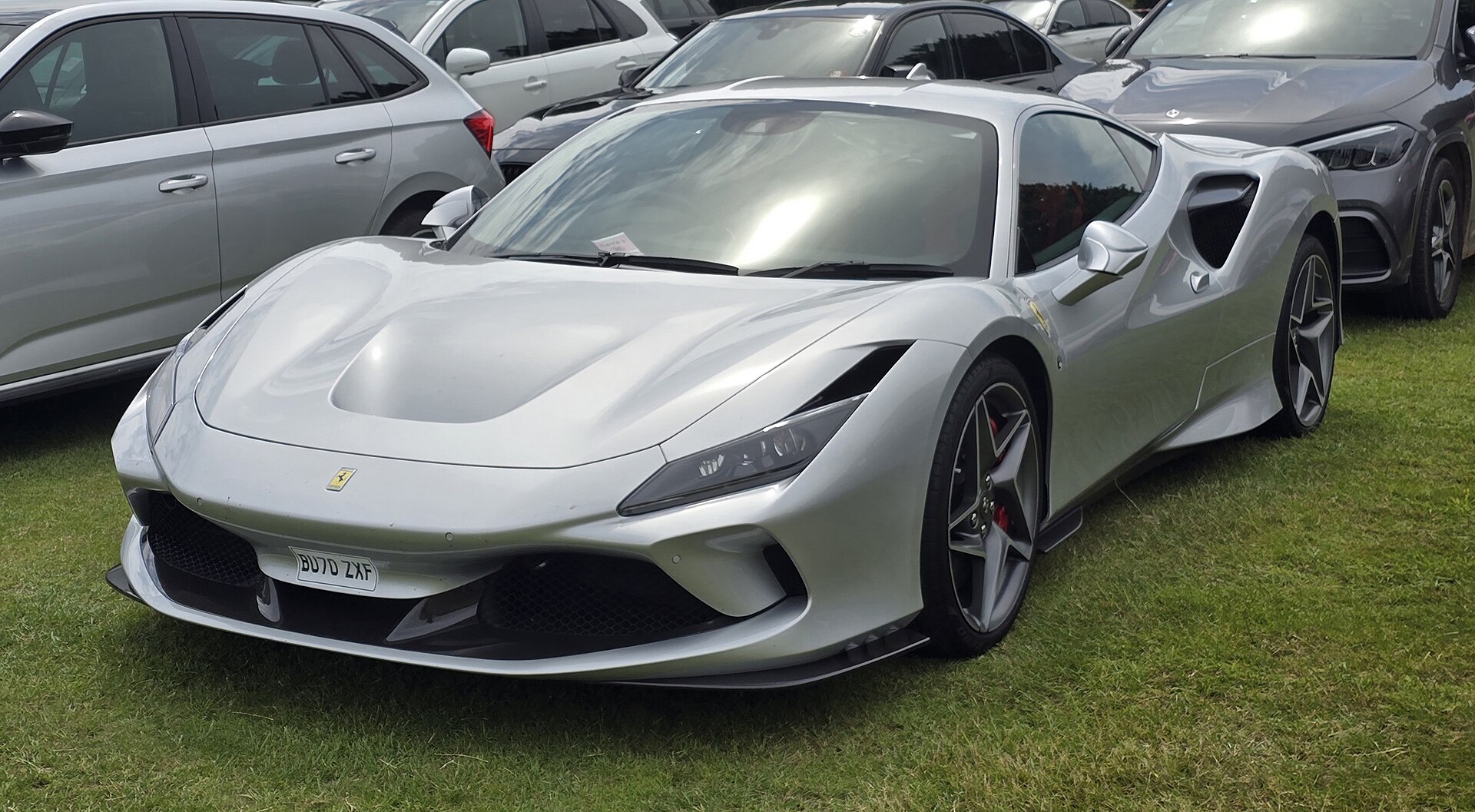
Is a Ferrari F8 Tributo Worth Buying?
The F8 Tributo is the last naturally aspirated V8 Ferrari. With production ended and hybrid technology taking over, it's becoming automotive history. But is the premium price justified? Here's what you need to know.
The Short Answer: Yes, But with Critical Caveats
The Ferrari F8 Tributo is worth buying — but only for buyers who understand what they're purchasing and why. Unlike some collector cars that appreciate purely on rarity, the F8 Tributo has something far more meaningful: it's the final expression of Ferrari's pure V8 philosophy before the brand went hybrid. That matters profoundly. Every year that passes, this car becomes more historically significant, and historically significant Ferraris tend to hold value exceptionally well.
That said, the F8 Tributo is not a bargain. Used pricing sits between $250,000–$300,000 for the coupe and $280,000–$340,000 for the Spider. At those prices, you're making a statement. You're not buying the fastest supercar (the 296 GTB hybrid is faster). You're not buying the most refined (that's a McLaren or Porsche). You're buying a specific thing: the last pure V8 Ferrari mid-engine sports car ever made.
We've helped hundreds of exotic car buyers through Automonitor, and the buyers who are happiest with their F8 Tribuos are the ones who made that choice consciously. They knew what they were getting. They understood the costs. They weren't chasing raw performance metrics. This guide exists to help you decide if you're that buyer.
Why the F8 Tributo Matters: The End of an Era
Production ended in 2022. That simple fact changes everything about how you should think about this car. The F8 Tributo isn't a current model anymore — it's a final model. It's the last chapter in a narrative that started with the 488 in 2015, which itself was the successor to the beloved 458.
The 3.9-liter twin-turbo V8 produces 710 horsepower, identical to the 488 Pista but paired with refined aerodynamics and a more livable chassis. It hits 60 mph in 2.9 seconds, with a top speed of 211 mph. On paper, the 296 GTB hybrid beats those numbers. But numbers don't capture the significance of what the F8 represents: it's the mechanical endpoint of Ferrari's V8 era.
Compare this to the Lamborghini Huracan. When Lamborghini ended Huracan production in 2024, enthusiasts suddenly realized they were holding the last naturally aspirated V10 supercar. Prices didn't spike overnight, but values stabilized, and certain variants started appreciating. The same dynamic is already playing out with the F8 Tributo. The market is slowly recognizing what this car will mean in ten years.
Ferrari doesn't sell purely on performance anymore. They never did. They sell on history, heritage, and the emotional significance of owning something that will never be made again in its current form. The F8 Tributo benefits enormously from that dynamic.

The Real Comparison: F8 Tributo vs. 488 GTB — Is the Premium Justified?
If you're seriously considering an F8 Tributo, you're probably also looking at the Ferrari 488 GTB it replaced. The 488 is cheaper — you can find well-maintained examples for $200,000–$250,000. The F8 costs $250,000–$300,000 minimum. That's a meaningful premium for essentially the same powertrain in a more refined package.
| Spec | 488 GTB | F8 Tributo | Winner |
|---|---|---|---|
| Engine | 3.9L Twin-Turbo V8 | 3.9L Twin-Turbo V8 | Tie |
| Horsepower | 661 hp | 710 hp | F8 (49 hp advantage) |
| 0–60 mph | 3.0s | 2.9s | F8 (marginal) |
| Aerodynamics | Good | Significantly improved | F8 (much better) |
| Cabin Refinement | Good | Superior ergonomics | F8 |
| Current Market Price | $200K–$250K | $250K–$300K | 488 (cheaper) |
| Production Run | 2015–2019 | 2020–2022 (shorter, rare) | F8 (rarity value) |
| Resale Outlook | Stable | Appreciation potential | F8 |
The honest answer: yes, the F8 premium is justified, but only for specific buyers. If you're buying purely for driving dynamics and raw performance, the 488 GTB is the better value. If you're buying because you understand that the F8 is the final V8 Ferrari and you want to own that piece of history, the premium makes sense. The shorter production window (2020–2022) also means fewer were made, and scarcity creates value in the luxury market.
The F8 Tributo Lineup: Coupe vs. Spider
Ferrari offered two variants: the hardtop coupe and the convertible Spider. Both share the same 710 hp engine and identical performance figures.
F8 Tributo Coupe
The "original" configuration, more focused on performance and structural rigidity. Current pricing runs $250,000–$300,000. The coupe is notably stiffer and slightly more responsive on track, though the difference is marginal for street driving.
F8 Spider
The retractable hard-top convertible version. Pricing is $280,000–$340,000 due to added complexity and convertible demand premium. The Spider is more expensive to maintain (retractable roof mechanism), but offers the visceral experience of driving a $300K car with no roof.
For pure investment and depreciation profile, the coupe is slightly better. For driving enjoyment on nice weather days, the Spider commands serious consideration.

What the F8 Actually Costs: The Full Picture
Purchase price is only the beginning. Here's the full annual cost breakdown for F8 Tributo ownership:
| Expense Category | Annual Cost Range | Notes |
|---|---|---|
| Insurance | $5,000–$9,000 | High-net-worth policies with agreed value |
| Routine Maintenance | $4,000–$6,500 | Oil changes, filter service, inspections |
| Fuel | $3,500–$5,000 | 12–14 mpg combined; 98 octane required |
| Tires (amortized) | $2,000–$3,500 | Michelin Pilot Sport 4S; every 10K–12K miles |
| Brakes (amortized) | $1,500–$2,500 | Carbon ceramic; $12K–$16K per replacement |
| Registration & Storage | $2,000–$4,000 | Climate-controlled storage recommended |
| Total Annual Running Cost | $18,000–$30,500 | Excludes major repairs, depreciation |
That's roughly $1,500–$2,500 per month in running costs alone, before the car depreciates a single dollar. If you purchase at $280,000 and lose 15% of value over three years, you're looking at $14,000 in annual depreciation on top of the running costs. Total ownership cost approaches $2,000–$3,300 per month.
At those numbers, the F8 only makes financial sense if the purchase price doesn't meaningfully strain your liquidity. This isn't a car to stretch for.
Depreciation Profile: Better Than You'd Expect
Here's where the F8 Tributo's value proposition gets interesting. Unlike most supercars, which lose 30–40% of their value in the first five years, the F8 is holding value remarkably well.
Early pricing data suggests the F8 loses approximately 10–15% of its value in the first three years, then stabilizes. That's substantially better than the 488 GTB, which lost roughly 20–25% in the same period. The difference is almost certainly due to the "last V8" narrative and the shorter, rarer production run.
If you buy an F8 Tributo at $280,000 and own it for three years, you might sell for $238,000–$252,000. That's roughly $28,000–$42,000 in total depreciation spread across 36 months — or about $778–$1,167 per month. For a supercar, that's genuinely affordable.
The F8 Tributo is becoming a collector car while still being a current-generation performance machine. That's a rare position that favors buyers who understand the long-term calculus.

Reliability: Twin-Turbo Complexity with Ferrari Reputation
The F8 benefits from the proven 488 platform and powertrain. The 3.9-liter twin-turbo V8 is one of Ferrari's most reliable modern engines — multiple owners report 15,000–25,000+ miles without major issues. The turbocharged platform is more robust than you might expect, particularly compared to older naturally aspirated Ferraris.
That said, there are known weak points you should understand before buying:
- Carbon Buildup: Direct-injection turbocharged engines are prone to carbon accumulation on intake valves over time. Some owners report symptoms around 20,000–30,000 miles: rough idle, hesitation at low rpm, slight loss of smoothness. Professional walnut blasting cleaning (roughly $3,000–$5,000) resolves this. Plan for one cleaning over the car's ownership life.
- Dual-Clutch Transmission (DCT): The 7-speed has occasional reports of shift hesitation or shuddering in heavy traffic. These are rare, but always test drive extensively before purchase. DCT service or replacement is expensive ($12,000–$18,000) if needed.
- Turbocharger Bearing Wear: At extreme mileage (40,000+), some owners report early turbo bearing noise or slight loss of boost response. Regular maintenance and quality oil changes are essential preventive measures.
- Electrical Gremlins: Infotainment glitches, occasional sensor faults, and software-related issues have been reported. These are typically software-fixable at Ferrari dealers but can be annoying.
- Water Pump Seals: The cooling system can develop slow leaks around pump seals in high-mileage examples. This is a $4,000–$6,000 repair if it occurs.
Overall, the F8 is reliable by exotic car standards. It's not a Honda Civic, but it's light-years more dependable than a 458 or 430. The combination of Volkswagen Group sourcing (via parent company Aston Martin's technical partnerships) and Ferrari's refined engineering creates a genuinely livable supercar.
Get a Certified Pre-Purchase Inspection
Before committing to an F8 Tributo, Automonitor connects you with Ferrari-certified inspectors who know exactly what to look for. A thorough PPI can save you tens of thousands in hidden repairs.
Schedule Your Inspection →How It Compares: F8 Tributo vs. 296 GTB vs. McLaren 720S vs. Huracan Evo
The F8 Tributo exists in a specific segment — V8 supercars approaching $300K in the used market. Here's how it stacks up against the most likely competitors:
| Category | F8 Tributo | 296 GTB | McLaren 720S | Huracan EVO |
|---|---|---|---|---|
| Engine | 3.9L Twin-Turbo V8 | 3.0L Twin-Turbo V6 + Hybrid | 4.0L Twin-Turbo V8 | 5.2L NA V10 |
| Horsepower | 710 hp | 818 hp | 710 hp | 630 hp |
| 0–60 mph | 2.9s | 2.9s | 2.7s | 2.8s |
| Used Market Price | $250K–$300K | $380K–$450K | $140K–$180K | $155K–$190K |
| Driving Feel | Pure, responsive V8 | Hybrid complexity | Lightweight precision | Natural aspiration glory |
| Sound | Turbocharged V8 exhaust | V6 hybrid hum | Turbocharged scream | NA V10 symphony |
| Rarity | Last pure V8 Ferrari | Current model (common) | Well-produced | Last NA V10 Lambo |
| Depreciation (3-yr) | 10–15% | ~20% | ~25% | ~18% |
The 296 GTB is faster and more powerful but costs significantly more and lacks the "final era" appeal that makes the F8 historically significant. The McLaren 720S is cheaper with sharper dynamics but depreciates faster. The Huracan offers a natural aspiration experience the F8 can't match, but at lower price and power levels.
The F8 occupies a unique middle ground: pure V8 turbocharged performance with Ferrari heritage, priced $70,000–$100,000 below the newer hybrid 296 GTB, and with strong value retention that rivals much cheaper cars.
How to Buy Intelligently: Step-by-Step Process
Step 1: Finance Before You Shop Exotic car lenders like JJ Best Banc and Woodside Credit specialize in this segment. Pre-approved financing gives you negotiating leverage and ensures you're making decisions based on real numbers, not enthusiasm.
Step 2: Define Your Mileage Threshold Low-mileage examples (under 5,000 miles) command premiums but come with fewer reliability unknowns. Mid-mileage cars (5,000–15,000 miles) offer better value. High-mileage examples (15,000+ miles) should be scrutinized aggressively. Personally, we prefer cars with moderate, well-documented mileage over garage queens.
Step 3: Search Broadly Across Channels Check Automonitor's marketplace, Ferrari dealers, Bring a Trailer, Cars and Bids, and independent exotic dealers. Pricing varies by source. Ferrari dealers charge premiums but offer warranty backing. Auction sites have competitive pricing but require more due diligence.
Step 4: Verify Service History Meticulously Every documented service visit matters. Missed services (oil changes, inspections) are red flags. Request the complete service book and cross-reference it with mileage shown in ads. Inconsistencies should kill the deal immediately.
Step 5: Get a Pre-Purchase Inspection from a Ferrari Specialist Non-negotiable. A thorough PPI costs $1,500–$2,500 and can identify $10,000+ in deferred maintenance. The inspection should specifically check the turbocharger condition, transmission smoothness, cooling system, carbon buildup history, and brake condition.
Step 6: Negotiate from Data, Not Emotion Know completed F8 sales prices from Bring a Trailer archives, sold listings on dealer sites, and market comps. Factor in condition, mileage, service history, and any needed maintenance. A car needing $5,000 in tire replacement or $3,000 in carbon cleaning should have those costs deducted from your offer.
Step 7: Plan Ongoing Maintenance From Day One Budget for annual service, tires every 10,000–12,000 miles, and preventive carbon cleaning around 20,000 miles. Factor these into your ownership calculus before you buy.
When the F8 Tributo Is NOT the Right Choice
You're buying purely as an investment. While the F8 holds value better than most supercars, it's not a stock. Insurance, maintenance, storage, and depreciation eat into any theoretical upside. Buy it to drive it, not to flip it.
You want the newest, fastest Ferrari. That's the 296 GTB. The F8 is the final V8, but it's not the latest generation. If cutting-edge technology matters to you, go hybrid.
You need daily usability. The F8 can be driven daily, but it's uncomfortable in traffic, has minimal trunk space, poor visibility, and terrible fuel economy. A Lamborghini Huracan EVO or McLaren 720S is more livable. The 488 Pista Spider might also be worth considering if you want convertible convertible appeal at a slightly lower price point.
You haven't test-driven one. Some buyers find the cabin cramped, the steering too heavy in Strada mode, or the ride too stiff. Always drive before you buy.
When You Sell: Maximizing Your Exit
The smart buyer thinks about resale from day one. A few key factors determine your recovery percentage:
Specification Matters Enormously: Rosso Corsa (Ferrari red) is iconic but common. Giallo Modena (yellow) and Blu Pozzi (blue) command 5–10% premiums. Interior color, brake type (carbon ceramic commands a small premium), and specification rarity all impact resale.
Service History Is Everything: A car with complete service records at Ferrari dealers is worth 5–10% more than an identical car with spotty history. Keep every receipt, every work order, every inspection report.
Mileage Trajectory Matters: A car with 8,000 miles after four years (2,000/year) is ideal. A car with 3,000 miles after four years looks like it wasn't driven, which can actually reduce value (unused cars develop problems). Consistent, moderate mileage is the sweet spot.
Storage and Care Show: Cars stored indoors with climate control hold value better. Garage queens with mysterious storage gaps get scrutinized on resale. Buyers want proof that the car was enjoyed and well-maintained.
When you're ready to sell, Automonitor's selling service handles the entire process — market valuation, professional photography, listing across channels, buyer vetting, and transaction coordination. You get market-rate pricing without the hassle of dealing with tire-kickers and lowballers.
The Final Verdict
The Ferrari F8 Tributo is worth buying if you understand exactly what you're purchasing: the final V8 Ferrari before the brand went hybrid, offered at a price point that remains accessible compared to the newer 296 GTB, with a depreciation profile that's genuinely favorable for a supercar.
You're not buying the fastest car in the segment. You're not buying the most refined. You're buying a piece of automotive history at the moment it becomes historically significant. That's not a small thing.
The ownership costs are real ($18,000–$30,500 annually). The purchase price is substantial ($250,000–$300,000). The commitment is genuine. But if you can afford it without financial strain, understand the mechanics of ownership, and appreciate what the "last V8" means, the F8 Tributo is genuinely one of the best purchases you can make in the $250K–$300K supercar segment.
Do your homework. Get a pre-purchase inspection. Understand the full costs. Choose your specification carefully. And if you want guidance navigating the process, Automonitor is here to help. We've done this hundreds of times, and we'll make sure you end up in the right car at the right price.
Ready to Find Your F8 Tributo?
Automonitor sources from verified Ferrari dealers and specialist exotic sellers worldwide. We handle inspections, negotiation, and logistics so you can buy with confidence.
Start Your Search →