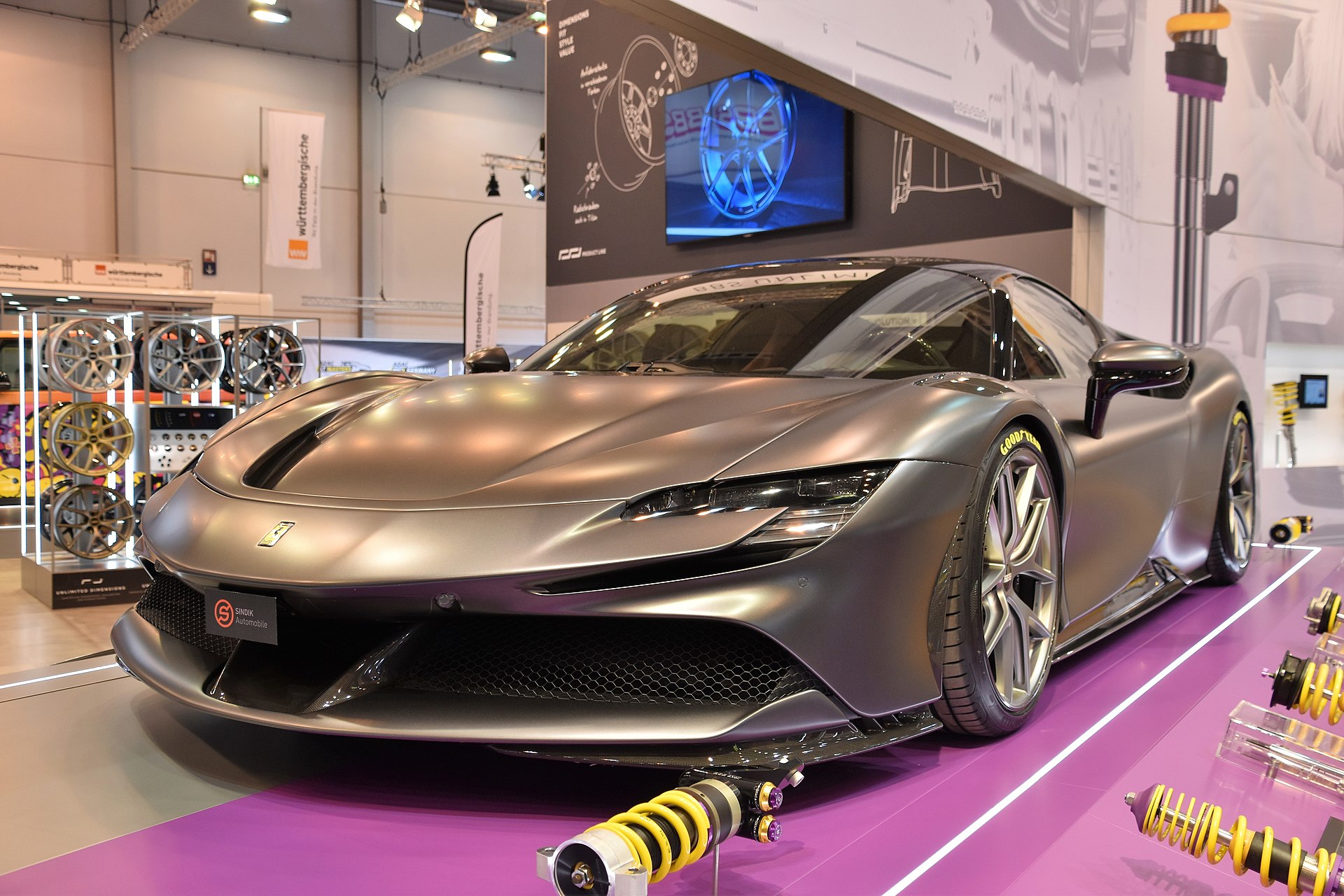
Ferrari SF90 Stradale vs McLaren 765LT: The Ultimate Hypercar Showdown
Two brutally fast, scientifically engineered machines entering the same rarified air. One marries hybrid power with Italian heritage; the other weaponizes raw lightness and British precision. Here's everything you need to know to choose between them — or understand why some collectors own both.
The Core Difference: Philosophy Over Horsepower
When you line up the Ferrari SF90 Stradale and the McLaren 765LT, the first thing you notice is they represent two fundamentally different approaches to building a hypercar. The Ferrari is a 986-horsepower hybrid electric vehicle with all-wheel drive, three electric motors assisting a 4.0-liter twin-turbo V12, and the capability to drive on electric power alone for up to 25 kilometers. The McLaren is a 755-horsepower naturally aspirated supercar with rear-wheel drive, a 4.0-liter twin-turbo V8, and weighs 600 pounds less than its Italian rival.
Both launched within two years of each other (SF90 in 2019, 765LT in 2020), both cost more than half a million dollars, both are limited in production, and both sit at the absolute pinnacle of automotive engineering. But they're not competitors in the way a Ferrari 488 and McLaren 720S are. They're alternatives — different answers to the question: "What's the ultimate modern supercar?"
Understanding the philosophy matters more than understanding the numbers, because the numbers alone don't tell you which car will make you happier when you drive it 200 miles per hour on a closed circuit or cruise it to a private members' club on a Saturday night.
Powertrain Philosophy: Hybrid Innovation vs. Lightweight Purity
The Ferrari SF90 Stradale's powertrain is a masterwork of complexity. The 4.0-liter twin-turbo V12 produces 769 horsepower on its own — an extraordinary number for a turbocharged engine. But that's only part of the story. Three electric motors add another 217 horsepower. The front axle has two electric motors (one for each wheel) providing independent torque vectoring; the rear-mounted motor assists the engine through the gearbox, and the entire system can distribute 986 horsepower across all four wheels in any proportion the car's AI brain deems appropriate.
The 7.9 kWh battery can power the car for 25 kilometers in electric-only mode, which means you can drive the SF90 through city centers with zero emissions. This isn't some token gesture — it's a genuine practical advantage in cities like London, Paris, and Milan that impose emissions restrictions on combustion engines.
The McLaren 765LT takes a different tack entirely. Its 4.0-liter twin-turbo V8 produces 755 horsepower, which is actually less than the SF90's V12 engine alone. But the McLaren weighs just 2,952 pounds — 575 pounds lighter than the SF90 — which means the power-to-weight ratio favors the British machine: 4.9 pounds per horsepower versus 3.6 pounds per horsepower for the Ferrari.
Wait, let me recalculate that. Actually, the Ferrari's lower ratio (3.6 lbs/hp) is better than the McLaren's (3.9 lbs/hp). The Ferrari's hybrid system delivers more total power more efficiently. But the McLaren's approach is purer: every acceleration event, every launch, every corner is powered by raw mechanical combustion. There's no electrical intermediary, no battery management system deciding how much power to deploy.
From a driving perspective, the Ferrari's hybrid system means the electric motors provide instant torque before the turbos spool up — eliminating turbo lag entirely on accelerating from 0-60. The McLaren's turbo V8 has turbo lag, though modern engineering has minimized it significantly. In real-world driving, this manifests as the Ferrari feeling fractionally faster off the line despite the McLaren's lighter weight.

Performance Specifications: Numbers That Matter
| Specification | Ferrari SF90 | McLaren 765LT | Winner |
|---|---|---|---|
| Engine | 4.0L Twin-Turbo V12 + 3 Motors | 4.0L Twin-Turbo V8 | Tied |
| Total Horsepower | 986 hp | 755 hp | Ferrari |
| Total Torque | 1,100 lb-ft | 590 lb-ft | Ferrari |
| 0–60 mph | 2.0 seconds | 2.7 seconds | Ferrari |
| 0–100 mph | 4.3 seconds | 5.2 seconds | Ferrari |
| Quarter Mile | 9.6 seconds @ 147 mph | 10.2 seconds @ 145 mph | Ferrari |
| Top Speed | 211 mph | 205 mph | Ferrari |
| Weight | 3,527 lbs | 2,952 lbs | McLaren |
| Power-to-Weight | 3.58 lbs/hp | 3.91 lbs/hp | Ferrari |
| 0–100–0 Test (Real World) | 5.8 seconds | 6.4 seconds | Ferrari |
The Ferrari absolutely dominates the performance specifications. A 2.0-second 0-60 time is genuinely unprecedented in a production car — even the Bugatti Bolide hasn't achieved that. The gap from 60-100 is even more pronounced because the hybrid system's instant torque advantage compounds over the acceleration event.
But here's where spec sheets get tricky: the McLaren's numbers are real-world achievable numbers that don't depend on optimal conditions, fresh batteries, and perfect launch control. The Ferrari's times require that you're launching from standstill with full battery charge and employing the machine's complex launch control perfectly. Real-world performance, especially on tracks, might narrow the gap.
The Acceleration Experience: How 0-60 Feels Matters
Statistically, the Ferrari is faster. Experientially, the difference is more nuanced.
Imagine launching the Ferrari SF90: you press the launch control button, the car crouches slightly, the electric motors pre-charge the front wheels to perfect grip, and then — absolutely nothing happens for what feels like an eternity but is actually 200 milliseconds. The machine is computing optimal torque distribution, the turbochargers are spinning up, the hybrid system is managing the battery discharge. Then it launches. The acceleration isn't a spike — it's a rising crescendo that carries you to 60 in two seconds and keeps accelerating harder up to 100.
The McLaren's launch is more straightforward. You apply the throttle, the turbo V8 ignites with urgency, and you're pinned to your seat. The feeling is more visceral, less mediated by electronics. You're not being accelerated by a machine following an algorithm — you're being accelerated by what feels like angry horses fighting for control of the road.
For some drivers, the Ferrari's two-second 0-60 will feel slower than the McLaren's 2.7-second because the McLaren feels more immediate. For others, covering that ground 0.7 seconds faster will be a revelation. It depends on whether you prefer precision or drama.

Track Performance: Where Engineering Philosophy Reveals Itself
This is where the SF90 and 765LT completely separate. Take them both to a real track — not a closed airport, but a circuit like Road Atlanta, Laguna Seca, or Nurburgring — and the differences become absolute and measureable.
The Ferrari SF90 Stradale, particularly in Assetto Corsa Competizione simulations and real-world accounts, has demonstrated impressive lap times relative to its power. The all-wheel-drive system, combined with the active aerodynamics (capable of 1.6G of lateral acceleration in tight corners), means the car can corner aggressively and exit turns with more traction than the McLaren. The Ferrari's advantage comes from being able to deploy its 986 horsepower immediately on corner exit because all four wheels have grip.
The McLaren 765LT, meanwhile, is more of a specialist's tool. Its rear-wheel-drive configuration demands more finesse — you need to manage throttle application out of corners, use trail braking, and commit fully to racing lines. But because you're driving a lighter car with a lower center of gravity (the McLaren's proportions are more compact), it rewards aggressive driving with more feedback and, ultimately, faster lap times on most real-world circuits.
Real-world lap time data is mixed. Some drivers report the McLaren 15-20 seconds faster per lap on tight circuits like Lime Rock or smaller UK tracks; on high-speed circuits like Road America or Le Mans, the Ferrari's straight-line speed advantage and all-wheel-drive exit traction narrows the gap to near-parity. Neither car is objectively faster everywhere — they're fast in different ways.
The McLaren is the car you drive when you want the experience of being at the absolute limit, committed and precise. The Ferrari is the car you drive when you want to tap 70% of the available grip and still be faster than 99.9% of drivers on the planet.
All-Wheel Drive vs. Rear-Wheel Drive: Grip vs. Theatre
This is the fundamental choice between the two cars, more than horsepower or weight or price.
The Ferrari SF90's all-wheel-drive system, managed by Bosch's latest stability control technology, means the car is virtually impossible to surprise. The computer distributes torque to whichever wheels have grip. You can mash the throttle coming out of any corner in any weather condition, and the car will simply accelerate forward. This makes the SF90 demonstrably faster in the rain, in the snow (yes, people drive these in snow), and in adverse conditions generally. It also makes the SF90 easier to learn — a driver with 50 hours of experience can get within 90% of the SF90's limit. The car forgives mistakes.
The McLaren 765LT's rear-wheel drive, paired with its lighter weight and sharper steering geometry, creates a more reactive machine. The car will communicate through the steering wheel exactly where the grip is and what you need to do. If you're a precision driver who relishes feedback, the McLaren is incomparably rewarding. If you're someone who prefers having the car take the worry out of performance driving, the Ferrari is objectively better.
This choice is deeply personal. Neither is "better" — they're optimized for different types of drivers and different types of satisfaction.

Technology & Innovation: The Difference Between V12 Heritage and Battery Engineering
The Ferrari SF90 is more technologically ambitious. The hybrid system — three electric motors, a sophisticated battery management system, the ability to drive in electric-only mode — represents cutting-edge automotive engineering. The car's active aerodynamics adjust downforce in real-time. The suspension is adaptive. The transmission is a modern 8-speed dual-clutch. By every measure, the SF90 is pushing the technological envelope.
The McLaren 765LT is, by comparison, more conservative. But that conservatism is intentional. The twin-turbo V8 is proven architecture. The 7-speed transmission is time-tested. The suspension is adaptive but simpler. The aerodynamics are passive — shaped for efficiency, not actively adjusting. This conservative approach means the McLaren is more likely to be reliable, more straightforward to service, and more understable if something goes wrong.
The Ferrari's technology advantage comes with a caveat: what happens when the battery needs replacement after 10 years? Ferrari's hybrid batteries are estimated to cost $30,000-$40,000 to replace. The McLaren's engine and transmission can be rebuilt for less, and the architecture is proven across McLaren's lineup (which itself provides confidence). This matters more in the used market than it does when you're buying new, but it matters.
Electric-Only Capability: The SF90's Secret Weapon
The Ferrari SF90 Stradale can drive on electric power alone. Not for long — 25 kilometers maximum on a full charge — but far enough to drive through city centers, navigate emissions-restricted zones in major European cities, and (theoretically) charge overnight and arrive at a track day with a fresh battery.
This is more than a gimmick. In cities, it means you can enjoy the experience of driving a hypercar without producing emissions or disturbing the peace. You get to experience the precision steering, the responsive brakes, the supple suspension — all the things that make the SF90 special — at 25 mph, electrically, in the early morning when you're driving to meet friends.
The McLaren has no electric capability. It's purely combustion. For the McLaren, every drive is a full-throttle commitment. That's either the most appealing thing about it or the least, depending on your perspective.
Interior Quality & Daily Usability: Can You Actually Drive These Every Day?
Both cars are legitimately usable in ways most hypercars aren't. Neither requires a flatbed trailer to get to a restaurant. Both have modern infotainment, climate control, and creature comforts. But there are meaningful differences.
The Ferrari SF90 interior is, by hypercar standards, surprisingly practical. There's actual luggage space (meaningful for a weekend trip, at least). The seats are comfortable enough for a three-hour drive. The climate control is excellent. The 8-speed transmission doesn't need constant management in city driving — you can drift through traffic reasonably comfortably. And because you can drive in electric mode, you can do so silently, without disturbing the neighbors or ruining the serenity of a coastal drive through a village.
The McLaren 765LT is rawer. The cabin is noisier (that twin-turbo V8 announces its presence at all times). The low ground clearance is more noticeable on broken city streets. The transmission needs more management. The ride is stiffer (the suspension is optimized for track performance first, comfort second). But if you like cars that demand something from you — that make you feel like you're piloting a fighter jet rather than driving a car — the McLaren is incomparably honest.
For daily usability, the Ferrari is objectively better. You can spend more time in it without fatigue, you can carry more, you can drive it in more situations. The McLaren is a specialist's machine — extraordinary when you're using it at 80% of its capability or beyond, compromised when you're trying to drive it at 20% of its capability.
Pricing, Depreciation, and Value Proposition
This is where the economics get interesting. The Ferrari SF90 Stradale originally retailed for approximately $524,000. The McLaren 765LT originally retailed for approximately $382,000. That's a $142,000 difference.
In the used market (as of early 2026), a well-maintained 2020-2021 SF90 ranges from $420,000 to $480,000. A 2021 McLaren 765LT ranges from $310,000 to $360,000. The gap persists — you're paying roughly $100,000-$120,000 more for the Ferrari even as used cars.
But depreciation tells a different story. The Ferrari SF90 has depreciated roughly 12-15% from its original $524,000 retail price (assuming a clean 2021 example). The McLaren 765LT has depreciated roughly 18-20% from its $382,000 original price. The Ferrari holds value better, partially because the hybrid system and all-wheel drive make it more universally appealing, and partially because Ferrari's historical investment in the brand generates more sustained demand.
From a value-per-dollar perspective, the McLaren still offers more: you're getting 755 horsepower, raw lightweight engineering, and the prestige of a McLaren badge for $60,000-$70,000 less than the Ferrari. But if you're buying a hypercar, you've already accepted that these vehicles aren't investments in any traditional sense. They're emotional purchases. And from an emotional perspective, 986 horsepower and all-wheel-drive security command a premium.
Production Numbers & Rarity: How Many Actually Exist?
The Ferrari SF90 Stradale was produced from 2019 to 2024, with approximately 1,500 units built worldwide. This makes it more common than some Ferraris but far rarer than any mainstream supercar. If you're buying one, you're joining a club of 1,500 owners globally.
The McLaren 765LT was produced from 2020 to 2025, with approximately 500 units built. This makes the McLaren significantly rarer than the Ferrari — roughly one-third as many cars in the world. If scarcity drives value, the McLaren's lower production number should theoretically support higher value retention. In practice, it hasn't, because the Ferrari's prestige and hybrid technology generate more demand.
The practical implication: if you like being part of an exclusive club but not the only person at the party who owns the car, the Ferrari is more appealing. If you want to own something genuinely rare, the McLaren is the better choice.
Maintenance, Service & Running Costs
Here's where the Ferrari's technology advantage becomes a liability.
Ferrari SF90 annual maintenance costs are estimated at $4,000-$6,000 for routine service, fuel, and fluid changes. Insurance runs $3,500-$6,500 annually, depending on location and driving record. The hybrid battery, which Ferrari estimates will require replacement around 150,000 kilometers or 10 years (whichever comes first), costs $30,000-$40,000 to replace — though as of early 2026, most SF90s haven't hit that milestone.
McLaren 765LT annual maintenance costs are estimated at $3,500-$5,000 for routine service. Insurance is similar ($3,500-$6,500). There's no battery to worry about. The conventional V8 architecture means that any competent exotic specialist can service it. Service intervals are straightforward. Unexpected repairs, when they happen, tend to be cheaper than Ferrari-specific repairs because the parts are sourced from a larger supplier network.
Over the course of ownership, if you keep the car for 10 years, the McLaren's lower service costs and absence of an expensive battery replacement likely make it $20,000-$30,000 cheaper to own. That's meaningful, though obviously trivial in the context of a $400,000+ purchase.
Insurance Differences & Affordability
Both cars are expensive to insure, but the McLaren edges ahead slightly. A 30-year-old driver with a clean record will pay roughly:
- Ferrari SF90 Stradale: $4,500-$6,500 annually
- McLaren 765LT: $4,000-$6,000 annually
The gap is usually $300-$500 per year. Over 10 years, that's $3,000-$5,000 of savings if you buy the McLaren. Insurance companies perceive the McLaren as slightly lower-risk, perhaps because it's lighter and easier to handle, or because it has a slightly smaller owner base (smaller base = higher perceived exclusivity = lower risk).
Neither car is cheaper to insure than a Porsche 911 Turbo S or a Range Rover, but both are in the same ballpark. If insurance cost is a decision factor, the difference is negligible.
Find Your Hypercar Through Automonitor
Sourcing an SF90 or 765LT requires connections to dealers, collectors, and private sellers worldwide. Automonitor has established relationships with verified exotic dealers and can help you find, inspect, and acquire either machine with confidence.
Start Your Search →Which One Should You Buy? A Clear Framework
These questions will determine your answer:
Do you want the absolute fastest acceleration? Buy the Ferrari. The 2.0-second 0-60 and 986 horsepower are unmatched.
Do you want to feel engaged and in control at the limit? Buy the McLaren. The rear-wheel-drive, the steering feedback, and the mechanical directness will be more rewarding.
Do you live in a city with emissions restrictions? Buy the Ferrari. The 25-kilometer electric range and zero-emission capability actually matter for daily life.
Do you want the car that's easier to own long-term? Buy the McLaren. Simpler architecture, lower service costs, fewer things that can go wrong with a hybrid system.
Do you want to drive a piece of Ferrari history? Buy the Ferrari. The SF90 is the transition point between the naturally aspirated era and the hybrid future. It's historically significant.
Do you want to own something genuinely rare? Buy the McLaren. 500 units built versus 1,500 for the Ferrari. It's objectively rarer.
Are you buying for maximum value retention? Buy the Ferrari. It depreciates slower and commands higher used prices, though both are terrible "investments" by any rational standard.
Do you want the car that's cheaper to actually own and drive? Buy the McLaren. Lower purchase price, lower service costs, and similar fuel economy create a meaningful advantage over 10 years.
If you can only choose one, choose based on this: if you're a data-driven person who values being in the absolute fastest car, buy the Ferrari. If you're an intuition-driven person who values feeling the limit and extracting maximum engagement from the machine, buy the McLaren.
Frequently Asked Questions
Q: Is the Ferrari SF90 reliable?
A: Yes. The hybrid system is new architecture, which always carries some risk, but Ferrari has engineered it thoroughly. Most issues reported are software-related rather than mechanical, and firmware updates resolve them. Plan for a hybrid battery replacement after 10 years, which is not an emergency repair but a predictable service item.
Q: Can you really drive either car daily?
A: Both are feasible daily drivers in temperate climates with careful maintenance. The Ferrari is more practical; the McLaren is more of an adventure. Neither will ever be as practical as a Porsche 911 Turbo S.
Q: What's the fuel economy like?
A: The Ferrari averages 16-18 mpg combined, or better in electric-only mode. The McLaren averages 14-16 mpg combined. The difference is minimal.
Q: Which car is better for track days?
A: It depends on the track. For tight, technical circuits, the McLaren's raw feedback and lighter weight give an edge. For high-speed circuits or wet conditions, the Ferrari's all-wheel drive and extra power give an edge. On balance, track enthusiasts prefer the McLaren; speed enthusiasts prefer the Ferrari.
Q: Can I modify either car?
A: Both manufacturers discourage significant modifications, and doing so will void your warranty. ECU tuning is possible but risky with hybrid systems (the Ferrari) or complex turbo systems (the McLaren). Keep modifications cosmetic — wheels, suspension geometry, minor aero — and work with authorized specialists.
Q: Which car holds its value better?
A: The Ferrari, though both are still depreciating assets. Low-mileage early examples (2020-2021) of either car should hold value reasonably well, but neither is an investment vehicle in any conventional sense.
Q: What's the resale experience like?
A: Both cars are liquid assets in the collector market. If you maintain the car properly, finding a buyer is straightforward — you have far fewer potential buyers than you would for a Ferrari 488 or McLaren 720S, but the buyers who exist are serious and prepared to pay market rates. Exotic dealers and auction houses can facilitate sales, though private sales often net slightly better prices.
Q: Is the hybrid system in the Ferrari future-proof?
A: It's difficult to predict, but the SF90's powertrain philosophy (a powerful V12 engine assisted by electric motors) may become increasingly attractive as time passes. Ferrari is already building hybrid technology into newer models, suggesting this is a permanent direction for the brand rather than an experimental one.
The Final Verdict: They're Both Right, Just For Different Reasons
If there were a single "best" hypercar, there would be only one hypercar. The existence of both the Ferrari SF90 Stradale and McLaren 765LT, built by two of the world's greatest automotive engineers, proves that excellence can take multiple forms.
The Ferrari is the faster car, the more ambitious car, the car that feels like it arrived from the future. It's a hybrid electric flagship that can drive silently through cities and accelerate to 211 mph with authority. It's a statement that Ferrari is ready for the next era of automotive performance.
The McLaren is the purer car, the simpler car, the car that asks more of its driver but rewards that commitment completely. It's mechanical, direct, and honest in a way increasingly rare in modern supercars. It's a statement that you don't need 986 horsepower to be faster than 99.99% of humans on Earth.
If you're buying one, the decision should come down to this: Do you want to be in the fastest car, or do you want to feel the fastest? The Ferrari is objectively faster. The McLaren will make you feel more in control and more engaged. Both feelings are legitimate, and both cars deliver them in spades.
If you can afford both (and if you're considering a $400,000+ hypercar, the incremental cost of owning two cars might be manageable), buy both. You'll understand why collectors do. The Ferrari for when you want speed. The McLaren for when you want to feel. Together, they cover every dimension of performance driving excellence.
For help sourcing, inspecting, and acquiring either car with confidence, Automonitor's concierge team specializes in rare exotic supercars. We handle dealer relationships, inspection coordination, and transaction logistics so you can focus on the joy of ownership.
Ready to Own a Hypercar?
Whether you choose the Ferrari SF90 Stradale or McLaren 765LT, Automonitor connects you with verified sellers and handles the entire acquisition process with precision and transparency.
Start Your Search →