
Should I Buy a New or Used Mercedes-AMG GT?
The 2024 redesign fundamentally changed what the AMG GT is. The new car is a refined grand tourer. The previous generation is a raw, visceral sports car. Your choice between new and used isn't about money — it's about which car you actually want to drive.
The Two Generations: How They're Fundamentally Different
You need to understand something before you start shopping: the 2024 Mercedes-AMG GT and the pre-2024 AMG GT are essentially different cars. They share a nameplate. They share heritage. But they're built on different platforms, use different engineering philosophies, and deliver completely different driving experiences. This isn't an incremental refresh — it's a generational shift.
The previous generation (2015–2023) was front-mid-engine, rear-wheel-drive focused, and obsessed with delivering a raw, visceral driving experience. It was Porsche 911-adjacent in character — the sound, the feel, the engagement. The new generation (2024+) moved to a traditional front-engine layout, added all-wheel-drive capability, and prioritized comfort, technology, and grand-touring capability. It's more Mercedes S-Class coupe, less pure sports car.
This distinction matters enormously when deciding new vs. used. You're not choosing between a 2023 and 2024 model. You're choosing between two philosophies. Understanding which philosophy aligns with your priorities is the actual decision.
The New 2024+ AMG GT: A Modern Grand Tourer at $163,000
The redesigned AMG GT represents Mercedes' vision of what a high-performance coupe should be in 2024 and beyond. It starts at approximately $163,000 for the base AMG GT 53 4-door, with the twin-turbo 4.0-liter V8 versions (AMG GT 63 S E Performance) pushing toward $200,000+.
Key characteristics:
- 4.0L Twin-Turbo V8 (Base & Performance): 503 hp (53), 630 hp (63 S E Performance). This is the same 4.0L V8 used in the previous generation, engineered differently for more mid-range response and less high-RPM character.
- Hybrid Tech: The 63 S E Performance variant includes an electric motor for additional low-end torque and efficiency.
- MBUX Hyperscreen: The latest Mercedes infotainment system with over-the-air updates, Apple CarPlay, seamless integration.
- Advanced Safety Suite: Full suite of modern safety features — lane-keeping assist, adaptive cruise control, night vision, autonomous emergency braking.
- Comfort-Forward Suspension: Air suspension that prioritizes ride quality over track feel. You're sitting lower in the car than previous gens, with better insulation from road noise.
- All-Wheel Drive Standard: Unlike the rear-bias 2015-2023 generation, the new car can send power to all four corners, making it easier to drive hard and more predictable in bad weather.
- 4-Year / 50,000-Mile Full Warranty: Powertrain coverage, wear items covered, dealer network support worldwide.
The new AMG GT is what you buy if you want a daily-drivable supercar. The old AMG GT is what you buy if you want a sports car that happens to be drivable on street tires.
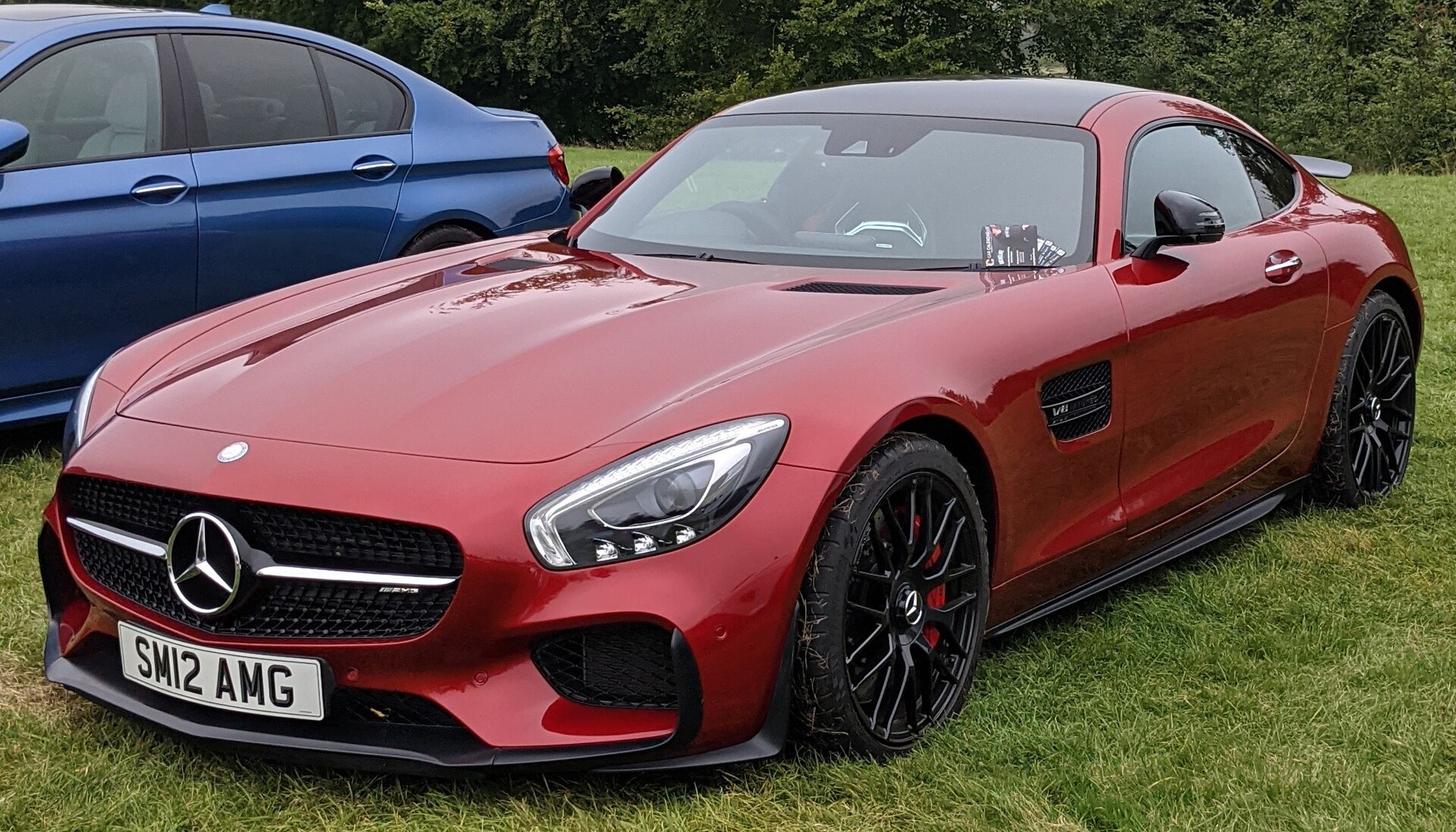
The Used Previous-Generation AMG GT: $75,000–$180,000 Depending on Variant
The AMG GT nameplate launched in 2015 with a single variant — the 585-horsepower GT. Over time, Mercedes added the GT S, GT R, GT Black Series, and various special editions. The market for these cars is now incredibly rich: used examples range from $75,000 for high-mileage 2015–2016 models to $180,000+ for rare, low-mileage GT Black Series or special edition cars.
Key characteristics:
- 4.0L Twin-Turbo V8 (Same Displacement, Different Tuning): The 2015-2023 cars make 503 hp (GT), 585 hp (GT S/GT R), and up to 710 hp (GT Black Series). This engine is more aggressive, louder, and more character-forward than the 2024+ generation.
- Front-Mid Engine Layout: The engine is positioned behind the front axle, not above it. This gives the car a more sports-car stance and handling character that enthusiasts crave.
- Rear-Wheel Drive Standard: Rear-biased handling, classic sports car feel. All-wheel drive was available but uncommon.
- Mechanical Simplicity: Older infotainment systems (pre-2020 models use older Mercedes COMAND systems). No over-the-air updates, but also fewer electrical gremlins than newer systems.
- More Raw Driving Experience: Tighter steering response, more mechanical feedback, less power steering assistance. The car feels more connected to the road.
- Naturally Aggressive Exhaust Note: Without turbo lag or electric motors, the V8 revving characteristics are more linear and more emotionally engaging.
- Mercedes CPO Program (if certified): Previous-generation cars sold as CPO come with a 1-year unlimited-mileage warranty extension, 165-point inspection, and roadside assistance. CPO pricing adds $3,000–$5,000 to private party value but provides significant peace of mind.
The previous generation isn't outdated — it's an older philosophy. And for many buyers, that older philosophy is exactly what they're looking for.
Head-to-Head Comparison: New 2024+ vs. Used Previous-Gen
| Factor | New 2024+ AMG GT | Used Previous-Gen (2020–2023) |
|---|---|---|
| Base Purchase Price | $163,000–$200,000+ | $120,000–$180,000 |
| Engine Character | Refined, tech-assisted | Raw, visceral |
| Warranty Coverage | 4 years / 50K miles full | 1–2 years if CPO; none if private |
| Infotainment | Latest MBUX, OTA updates | Older systems, no updates |
| Safety Technology | Full modern suite | Basic or absent |
| Driving Feel | Refined, forgiving | Engaging, responsive |
| Depreciation (5-year hold) | ~25–30% | Stabilized (already depreciated) |
| Annual Maintenance | $1,800–$3,000 | $2,000–$3,500 |
| Insurance | $3,500–$5,500/yr | $3,000–$6,000/yr |
| Best For | Daily driving, long trips | Weekend driving, engagement |

Depreciation: Why the Used Previous-Gen Looks Better on Paper
This is where the conversation gets interesting. A 2020 AMG GT 63 S that originally cost $175,000 now sells for $120,000–$135,000 used. That's dramatic depreciation — 23–31% over four years. But here's the key insight: that depreciation already happened. You're buying a car that has stabilized in value.
A 2024 AMG GT 63 S that costs $190,000 today will likely depreciate 25–30% over the next five years, putting its resale value around $130,000–$145,000. The new car will lose money at a similar pace as the used car already has.
The real difference: if you buy a 2020 used car for $125,000 and drive it for three years, you might sell it for $110,000–$120,000. Your depreciation is minimal. If you buy a 2024 new car for $190,000 and drive it the same three years, you might sell it for $140,000–$155,000. You've lost $35,000–$50,000 in value.
From a pure depreciation standpoint, buying used previous-generation makes more financial sense. From a warranty and peace-of-mind standpoint, buying new makes more sense. The economics depend on how long you plan to keep the car.
The Mercedes CPO Advantage: One of the Best Warranty Programs in Luxury
If you're considering a used previous-generation AMG GT, the Mercedes-Benz Certified Pre-Owned program is worth understanding. It's genuinely one of the best CPO programs offered by any luxury manufacturer.
What CPO includes:
- Automatic 1-year unlimited-mileage warranty extension (on top of remaining factory warranty)
- 165-point inspection covering systems, fluids, wear items, and more
- Roadside assistance (24/7 towing, lockout service, fuel delivery)
- Trip interruption reimbursement if the car breaks down while traveling
- Free scheduled maintenance (varies by program tier)
CPO cost premium: You'll typically pay $3,000–$5,000 more for a CPO-certified AMG GT than the same car sold as private party. For used previous-generation cars, this is typically money well spent.
A CPO 2020 AMG GT 63 S at $128,000 is meaningfully safer than the same car at $122,000 private party. The warranty extension protects you against transmission issues, electrical gremlins, and unexpected repairs. Over a 2–3 year ownership period, that CPO warranty could easily save you $5,000–$10,000 in repair costs alone.
This is where buying used with CPO actually makes financial sense versus buying new. You get a 1-year buffer on top of any remaining factory warranty, all the confidence of Mercedes' 165-point inspection, and you avoid the steepest part of the depreciation curve.

Running Costs: New and Used Are Surprisingly Similar
Many buyers assume that owning a new car will be cheaper than owning an old car. With the AMG GT, that assumption is mostly wrong. Both generations use the same 4.0-liter twin-turbo V8 (albeit tuned differently), and both require premium maintenance practices.
| Cost Category | Annual Cost (New 2024+) | Annual Cost (Used Pre-2024) |
|---|---|---|
| Insurance | $3,500–$5,500 | $3,000–$6,000 |
| Routine Maintenance | $1,800–$2,400 | $2,000–$3,000 |
| Fuel (Premium Only) | $2,800–$3,500 | $2,800–$3,500 |
| Tires (Amortized) | $800–$1,200 | $800–$1,200 |
| Brakes (Amortized) | $500–$800 | $600–$900 |
| Registration & Taxes | $1,500–$2,500 | $800–$1,500 |
| Total Annual Cost | $10,900–$16,000 | $10,000–$16,100 |
The similarity here is notable. The new car might be slightly cheaper to maintain (newer parts, fewer surprises), while the used car might be slightly cheaper overall because registration/tax scales with vehicle value. Over a five-year ownership period, the difference is marginal — maybe $2,000–$4,000 total, depending on mileage and service location.
This reinforces the key principle: your choice between new and used should be based on what kind of car you want to drive, not on running costs. Both will cost roughly the same to operate.
Finding the Right Generation for Your Needs
Automonitor sources both new and used AMG GT cars from certified dealers and private sellers. We handle inspections, warranty verification, and market comparison so you're confident in your decision.
Browse Available Inventory →Which Should You Actually Buy?
Buy the new 2024+ AMG GT if:
- You want a car that's primarily a daily driver with weekend performance capability
- Having the latest technology (MBUX Hyperscreen, OTA updates, modern safety features) matters to you
- You plan to keep the car for 5+ years and want a full manufacturer warranty for that entire period
- You regularly drive in harsh weather and value the stability that all-wheel drive provides
- You're not bothered by the loss of the front-mid engine layout and prefer the refined character of the newer generation
- You want to minimize the risk of unexpected mechanical issues
Buy the used previous-generation AMG GT if:
- You want a raw, unfiltered driving experience and value engagement over refinement
- You plan to drive the car 2,000–5,000 miles per year and don't need all-weather capability
- You want to minimize upfront purchase cost and avoid the steepest depreciation curve
- You're comfortable with older technology (the infotainment will be dated, but functional)
- You prioritize the front-mid engine layout and the steering response it provides
- You're willing to buy CPO to get warranty coverage and peace of mind
- Rarity and uniqueness appeal to you — special editions and variant availability is far richer in the used market
If you want a sports car, buy used previous-gen. If you want a grand tourer, buy new.
Specific Recommendations by Variant
Best Used Value: 2019–2021 AMG GT 63 ($110K–$140K)
The sweet spot for used purchase. These cars are out of the steep depreciation curve, widely available, and represent the most mature iteration of the previous generation. A 2020 CPO example with 20,000 miles delivers 90% of the experience of a newer car at 35–40% lower purchase price. See our detailed buying guide by year for mileage sweet spots.
Best New Value: 2024 AMG GT 53 ($163K)
The base 53 is overlooked but competent — 503 hp, all-wheel drive, latest tech, full warranty. If your budget is tight and you want new, the 53 delivers 80% of the performance of the more expensive 63 S E Performance at a significantly lower purchase price. Read our cost breakdown for detailed spec options.
Best Used Driver's Car: 2018–2019 AMG GT R ($130K–$160K)
585 hp, track-capable suspension, more aggressive tuning than the standard GT S. If you want serious performance from the previous generation, the GT R is the variant to chase. The market is thin (fewer were produced), but that makes good examples more valuable long-term. Check our sourcing guide for finding rare variants.
Best Investment: Rare Special Editions
The previous-generation had numerous special editions — AMG GT S Roadster, AMG GT Black Series (710 hp, $330K new, now $240K–$280K used), AMG GT R Roadster. These special variants are appreciating slightly as production ended, making them more interesting from a value-retention perspective than standard models. Check our detailed worth-buying analysis for variant appreciation trends.
The Smart Buying Process: Steps for Either Generation
For Used Previous-Generation:
- Define your variant priority (GT, GT S, GT R, special edition) and budget range
- Search broadly across certified Mercedes dealers, Bring a Trailer, Cars and Bids, and AutoTrader
- Get a pre-purchase inspection from an AMG specialist (not a general shop) — they'll know what to look for on the specific variant
- Verify transmission health (dual-clutch units have rare issues; feel for any shuddering below 2,000 RPM)
- Check service records — regular oil changes every 10,000 miles are critical on these turbocharged engines
- Prioritize CPO certification when available — the warranty extension is valuable
- Negotiate based on comparable sales data, not asking price
For New 2024+ AMG GT:
- Visit multiple Mercedes dealers to compare incentives and available inventory
- Build your specification online using the Mercedes configurator
- Negotiate the deal with dealer incentives, not the sticker price
- Verify the complete warranty package and scheduled maintenance coverage
- Arrange financing early (Mercedes Financial Services offers competitive rates)
- Consider wheel/tire package carefully — the Michelin Pilot Sport 4 S tires are excellent, and some dealers include free replacement
The buying process for used is more involved, but that's the trade-off for lower purchase price. The buying process for new is more straightforward but requires negotiation discipline.
Ready to Make Your Decision?
Whether you're leaning toward new or used, Automonitor can handle the entire process. Pre-purchase inspections, dealer negotiations, financing, title transfer — we handle it all so you don't have to.
Start Shopping Now →If You're Still Deciding: Comparable Alternatives
The AMG GT isn't the only high-performance coupe on the market. If you're genuinely torn between new and used, comparing to adjacent segments might clarify your priorities.
Consider a new Porsche 911 Turbo S if: You want proven reliability, unmatched resale value, and the most advanced driving dynamics in the segment. The 911 Turbo S costs $190,000–$215,000 new and holds value better than the AMG GT (loses only ~20% over five years vs. AMG GT's ~25–30%).
Consider a used Aston Martin Vantage if: You want British exclusivity with a similar visceral V8 experience to the used AMG GT. A 2019–2021 Vantage runs $80K–$120K and offers comparable performance with more exotic character.
Consider a new Porsche 911 GT3 if: You want raw performance from a new car. The GT3 costs $210,000 but delivers superb driving dynamics and slightly better depreciation than the new AMG GT 63 S E Performance.
Consider a new Bentley Continental GT if: You want extreme luxury alongside performance. The Continental is $235,000+ new but offers unmatched interior refinement. It depreciates similar to the new AMG GT.
Consider a used Porsche 911 Turbo S from 2020–2021 if: You want sports car credentials with lower purchase price. A used 2021 911 Turbo S costs $140,000–$165,000 and offers better reliability reputation than the AMG GT.
These comparisons highlight the key insight: the new AMG GT competes with other new grand tourers, while the used AMG GT competes with other used sports cars. Your choice isn't just new vs. used; it's about which generation's competitive set aligns with your actual needs.
The Final Answer
The 2024 redesign made the AMG GT a genuinely different car. It's more refined, more technology-forward, more capable in all weather. These are objective improvements for people who want a daily-drivable grand tourer.
But the previous generation had something the new car lost: raw character, visceral engagement, the feeling that you're driving something truly special. These are subjective qualities that no amount of technology can replicate.
There's no objectively "correct" choice. The correct choice is the one that aligns with how you actually want to drive. If that's comfortable, connected, with all the latest tech and a full warranty — buy new. If that's raw, engaging, at a lower purchase price, with the kind of specialness that comes from driving an older generation — buy used.
The financial math is nearly identical either way. Your decision should be emotional, not mathematical. Let that guide you, and you'll end up in the right car.