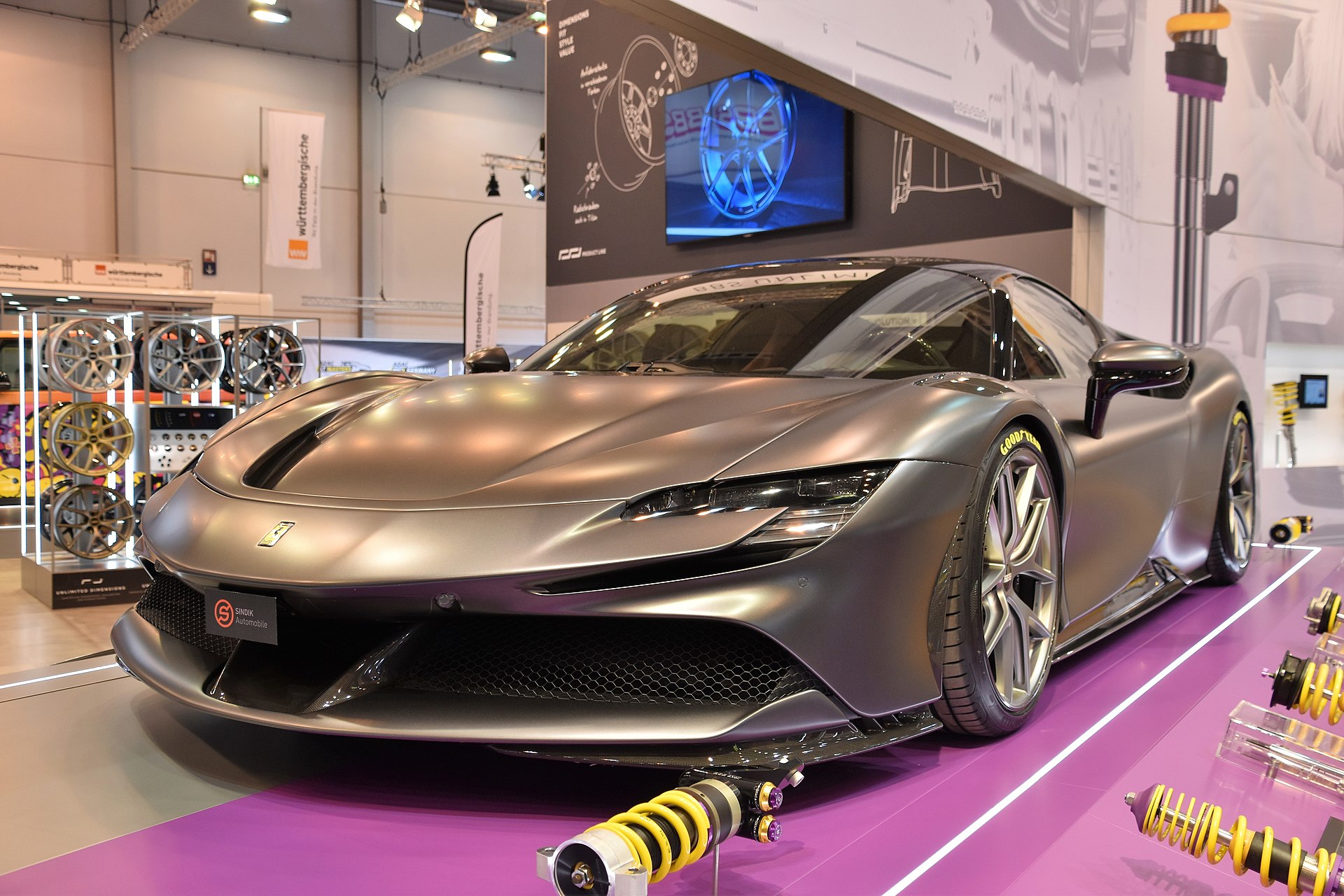
How Much Does a Ferrari SF90 Cost?
The Ferrari SF90 isn't just expensive — it's in a category that redefines what expensive means. Here's the complete breakdown of what you're actually paying for when you buy into Ferrari's hybrid future.
The Ferrari SF90: Ferrari's First Hybrid Hypercar
The Ferrari SF90 Stradale isn't an evolution of Ferrari's existing lineup — it's a revolution. Launched in 2019, the SF90 represents Ferrari's first production plug-in hybrid vehicle, a technological statement that the Prancing Horse is willing to embrace electrification without sacrificing the soul that has defined the brand for over seven decades.
Named after Ferrari's Formula 1 car designation, the SF90 isn't positioned as a spiritual successor to the 488 GTB. Instead, it exists in its own hypercar echelon — closer to a Lamborghini Revuelto in capability and stratospheric pricing than to traditional Ferrari sports cars. It sits above the standard sports car segment and competes with ultra-rare, six-figure exotics where depreciation moves in unexpected directions and ownership is less about practicality and more about possession of automotive history.
Three variants exist: the SF90 Stradale (the original coupe), the SF90 Spider (convertible, introduced 2021), and the track-focused SF90 XX Stradale (launched 2023). Each represents a different expression of the same 986-horsepower hybrid mentality, and each carries its own pricing structure in both the new and used markets.
The Powertrain: 986 HP of Hybrid Fury
The SF90's technical spec sheet reads like science fiction, but every number represents real engineering. At the core sits a 4.0-liter twin-turbocharged V8 that produces 769 horsepower and 590 lb-ft of torque — extraordinary figures for a naturally aspirated engine by itself, but only the beginning of the story.
Three electric motors push the total output to an eye-watering 986 horsepower combined. One motor sits in the transmission; the other two are mounted on the front axle, making the SF90 the first ever Ferrari with all-wheel drive. The battery pack is a 7.9 kWh lithium-ion unit mounted low in the chassis, optimized for weight distribution rather than range. Ferrari claims 6 miles of pure electric range — a number that sounds absurd until you realize it's designed for silent parking lot maneuvers and brief urban commutes, not cross-country road trips.
The SF90 achieves 0-60 mph in 2.5 seconds, 0-120 mph in 6.6 seconds, and a top speed of 211 mph. That's hypercar performance, full stop.
The transmission is an 8-speed dual-clutch automatic, with the electric front motors capable of vectoring torque independently to each wheel. The result is a car that can turn, accelerate, and brake with physics-defying precision. On track, the SF90 competes with hypercars costing significantly more. On the road, it's arguably the most technologically advanced car Ferrari has ever produced — and certainly the most complex.
This complexity matters when evaluating purchase decisions and ownership costs. More technology means more potential failure points, more specialized service requirements, and higher repair bills when something goes wrong. The trade-off is performance and prestige that no naturally aspirated Ferrari in the modern era can match.

New Pricing: MSRP vs. Reality
Ferrari's official MSRP figures for new SF90s represent the starting point in a labyrinthine pricing structure that includes mandatory factory options, dealer markups, and market fluctuations.
| Variant | Official MSRP | Realistic New Price | Market Markup |
|---|---|---|---|
| SF90 Stradale (Coupe) | $507,000 | $550,000–$600,000 | 8–18% above MSRP |
| SF90 Spider (Convertible) | $557,000 | $610,000–$680,000 | 9–22% above MSRP |
| SF90 XX Stradale (Track) | $599,000 | $680,000–$750,000 | 13–25% above MSRP |
These are not random numbers. Ferrari controls supply ruthlessly, allocating only a handful of SF90s to each global market per year. Demand has historically exceeded supply, allowing dealers and Ferrari itself to command premiums. During the pandemic chip shortage (2020–2022), new SF90s sold for $100,000–$150,000 above MSRP at some dealerships — a phenomenon that has since moderated as supply normalized.
However, 2026 still isn't a buyer's market for new SF90s. Production is winding down, with the SF90 nearing the end of its lifecycle. That means dealers are charging what the market will bear. Factory options add another $50,000–$150,000 easily. Carbon fiber packages, special paint finishes, bespoke interior treatments, and performance upgrades mount quickly.
A fully optioned SF90 Spider with carbon ceramic brakes, advanced aerodynamics package, and Assetto Fiorano track performance module can easily reach $750,000–$850,000. This is the reality of new hypercar purchasing: the sticker price is almost meaningless.
Used Market Pricing: The SF90 as a Commodity
The used market for SF90s presents a more sophisticated picture. Since the SF90 launched in 2019, fewer than 3,000 examples have been built worldwide. Supply is severely constrained, and those vehicles that do appear for sale are usually examples of specific market moments — owners upgrading to the XX Stradale, market corrections, or forced liquidations.
| Variant | Year | Mileage Range | Current Market Price | Premium/Discount |
|---|---|---|---|---|
| SF90 Stradale | 2019–2021 | 5K–20K miles | $400,000–$475,000 | -15% to -5% MSRP |
| SF90 Stradale | 2022–2023 | 2K–8K miles | $480,000–$550,000 | -5% to +8% MSRP |
| SF90 Spider | 2021–2022 | 3K–15K miles | $480,000–$570,000 | -10% to +2% MSRP |
| SF90 Spider | 2023 | Under 5K miles | $580,000–$650,000 | +4% to +17% MSRP |
| SF90 XX Stradale | 2023–2024 | Under 3K miles | $650,000–$800,000+ | +8% to +33% MSRP |
Notice the pattern: the SF90 doesn't depreciate in the traditional sense. A 2019 Stradale purchased new for $550,000 might be worth $440,000 today (2026) — that's a loss, but relatively modest for a six-year-old hypercar. A low-mileage 2023 Spider, by contrast, has often appreciated since purchase because demand exceeds available inventory.
The XX Stradale is particularly interesting. Limited to just 799 units globally, and positioned as the ultimate expression of the SF90 concept, the XX Stradale commands prices that often exceed new purchase pricing. An XX Stradale with under 2,000 miles might trade hands for $750,000–$850,000, representing a 25–40% premium over its new MSRP. This is the dynamic that makes certain supercars investment vehicles rather than depreciating assets.
Specification, color, service history, and provenance all influence pricing. A Rosso Corsa (Ferrari red) example with full carbon fiber package and complete Ferrari service history will command 10–20% premiums over an identical car with questionable ownership history or repainted panels. The SF90 market is sophisticated enough that buyers track specific cars through multiple sales, and significant price adjustments reflect known issues, accident history, or cosmetic damage.

Total Cost of Ownership: Why Purchase Price Is Just the Beginning
Buying the SF90 is straightforward. Owning it is where the real costs emerge.
| Expense Category | Annual Cost | Details |
|---|---|---|
| Insurance | $8,000–$15,000 | Hypercar rates; varies by location, driving record |
| Maintenance | $5,000–$10,000 | Oil changes, fluid services, diagnostics; 15K-mile intervals |
| Fuel | $3,500–$5,500 | Premium gasoline; 12–15 mpg combined |
| Tires | $4,000–$6,000 | Michelin Pilot Sport tire replacement every 8K–10K miles |
| Brakes | $2,000–$4,000 | Carbon-ceramic replacements $15K–$20K when due |
| Registration & Taxes | $1,500–$4,000 | State-dependent; California significantly higher |
| Battery Service (Amortized) | $800–$1,500 | Hybrid battery health checks, potential degradation monitoring |
| Annual Total | $24,800–$46,000 | Excludes repairs, accidents, or major component failures |
That's $2,050–$3,800 per month in running costs before the car loses a dollar in value. For a vehicle with six-figure depreciation, these numbers add up quickly. Over a typical three-year ownership period, expect to spend $75,000–$140,000 in operating costs alone.
Major repairs elevate this dramatically. A transmission repair on an SF90 can run $8,000–$15,000. Hybrid battery work, if needed, is in the $20,000–$40,000 range. Engine issues requiring partial disassembly quickly exceed $25,000. These aren't theoretical scenarios — they're documented expenses in various exotic car forums and service records that circulate in the used market.
Insurance is particularly steep. Most carriers require a minimum $2 million liability policy on an SF90. Theft, collision, and comprehensive coverage on a $500,000+ asset commands premiums that would bankrupt owners of ordinary vehicles. East Coast insurers quote $12,000–$15,000 annually for well-qualified buyers. West Coast rates are often 30–50% higher due to accident frequency and claim severity in urban markets.
Depreciation Analysis: When a Hypercar Doesn't Lose Money
The SF90 depreciation story differs substantially from traditional supercars. Unlike a McLaren 750S, which loses 30–40% of value over five years, the SF90 depreciation curve is flatter and sometimes nonexistent.
Year 1 Depreciation: New SF90s lose 8–12% of value in the first year as they transition from "delivery mile" status to "used" status. A $600,000 Spider drops to $530,000–$550,000 — a loss of $50,000–$70,000. This is surprisingly modest for a hypercar, reflecting limited supply and persistent demand.
Years 2–3 Depreciation: The rate of decline slows. A 2023 Spider that cost $650,000 new might be worth $600,000–$630,000 in 2026 — representing almost no depreciation or even appreciation depending on mileage and specification. This stability emerges because SF90 buyers are not price-conscious. They're buying exclusivity, and exclusivity appreciates when production ends.
Years 4–5 Depreciation: This is where the market fractures. Low-mileage, well-maintained examples begin to appreciate as the SF90 transitions from "current model" to "previous generation." Higher-mileage examples or those with known mechanical issues depreciate faster, eventually reaching a 20–30% loss from new. A 2019 Stradale with 30,000 miles might be worth $420,000–$450,000 in 2026 — representing a 20–24% loss from its original $550,000 purchase price.
The XX Stradale follows a different trajectory. As the final, most exclusive variant, the XX Stradale is unlikely to depreciate before 2028–2030. Owners of 2023 XX Stradales with under 5,000 miles are likely to see appreciation through 2026 as the car ages and becomes more historically significant.
Comparison perspective: A Lamborghini Revuelto at similar price points loses 15–25% in the first three years. A McLaren 750S loses 35–45%. The SF90's relative value retention is one of its strongest financial arguments, though it requires discipline (keeping mileage low, maintaining impeccable service records, preserving originality) and luck (avoiding accidents or mechanical issues).

SF90 vs. The Hypercar Competition: Price and Performance Comparison
The SF90 doesn't exist in a vacuum. It competes with hypercars at similar price points, each with different philosophies and ownership profiles.
| Vehicle | Engine | Horsepower | 0–60 mph | New MSRP | Used Market (2026) |
|---|---|---|---|---|---|
| Ferrari SF90 Stradale | 4.0L Twin-Turbo V8 + 3 E-Motors | 986 hp | 2.5s | $507,000 | $400K–$550K |
| Ferrari 296 GTB | 3.0L Twin-Turbo V6 + 1 E-Motor | 818 hp | 2.9s | $325,000 | $320K–$400K |
| Lamborghini Revuelto | 6.5L NA V12 + 4 E-Motors | 1001 hp | 2.5s | $600,000 | $550K–$680K |
| McLaren 750S | 4.0L Twin-Turbo V8 | 740 hp | 2.8s | $300,000 | $180K–$250K |
| Porsche 918 Spyder | 4.6L NA V8 + 2 E-Motors | 918 hp | 2.5s | $845,000 (MSRP 2015) | $1,000K–$1,300K |
The comparison reveals the SF90's positioning. It's more powerful than the F8 Tributo and 296 GTB, yet costs less than the Lamborghini Revuelto. It outperforms the McLaren 750S significantly, though the McLaren is faster in a straight line on some metrics. The Porsche 918 is rarer and holds value better, but it's a 2015-era design selling for substantially more in today's used market.
For buyers with $500,000–$600,000 budgets in 2026, the SF90 Stradale represents the most approachable hypercar with credible performance, hybrid technology prestige, and mid-pack depreciation. The SF90 Spider offers convertible thrills at higher cost and slightly worse depreciation. The XX Stradale appeals only to collectors and track enthusiasts with unlimited budgets.
Getting the Money: Financing a Half-Million-Dollar Car
Few individuals write a check for $500,000–$800,000 without financing. SF90 buyers typically rely on exotic auto lenders who specialize in this segment.
Loan Terms: Expect 20–30% down ($100,000–$200,000) and loan terms of 60–84 months. Interest rates range from 5.5–9.5% depending on credit score, down payment percentage, and vehicle age. A $450,000 SF90 Stradale financed at 7.5% over 72 months requires $6,735 monthly payments, plus insurance, maintenance, and fuel.
Lenders: Companies like JJ Best Banc, Woodside Credit Union, and various private banking institutions cater to exotic car buyers. Some Ferrari dealers facilitate financing through captive lenders or partner networks. Read our exotic car financing guide for detailed information on rates, terms, and qualification requirements.
Depreciation Risk: If an SF90 depreciates faster than anticipated (possible if major repairs emerge), buyers can find themselves underwater on the loan — owing more than the car is worth. This risk is real, which is why pre-purchase inspections and warranty documentation are critical components of any hypercar purchase strategy.
Buying vs. Leasing: And Why Leasing Rarely Works for Hypercars
Ferrari offers lease programs for SF90s, typically structured around three-year terms with 10,000–15,000 annual miles. Monthly payments on a new SF90 Spider lease are $8,000–$12,000, translating to $96,000–$144,000 per year before insurance and fuel.
For three years, that's roughly $300,000–$450,000 in total lease payments. A buyer who acquires a used SF90 for $480,000 and keeps it for three years might own the car outright by the end (or be financing the remaining balance). The lease buyer has no equity and must return the vehicle to a dealer at the end of the term.
Leasing makes sense if you want the prestige and warranty coverage without ownership risk. Buying makes sense if you plan to keep the car for 5+ years or if you're betting on appreciation (particularly with the XX Stradale). For three-year ownership horizons where you might sell and move on, used purchase is almost always more economical than leasing.
A Real-World Ownership Scenario: What $500,000 Actually Costs
Let's work through the real financials of owning an SF90 Stradale for five years, starting with a used purchase in 2026.
Acquisition (2026): Purchase a 2022 SF90 Stradale with 8,000 miles for $500,000. Down payment: $125,000. Financed amount: $375,000 at 7.5% over 72 months. Monthly payment: $5,625.
Year 1 Costs: Loan payments ($67,500), insurance ($10,000), maintenance ($6,000), fuel ($4,500), tires ($5,000), registration ($2,000). Total: $95,000. Add loan payment amortization: monthly payment of $5,625 × 12 months = $67,500 towards principal and interest.
Years 2–5 Costs: Annual operating costs average $22,500 (insurance $10,000 + maintenance $6,000 + fuel $4,500 + amortized tires/brakes $2,000). Loan payments continue at $5,625/month ($67,500 annually) through Year 4, then $0 in Year 5 once the car is paid off.
Total Five-Year Cost: Down payment ($125,000) + loan payments ($270,000) + operating costs ($90,000) = $485,000.
Sale Value (2031): A seven-year-old SF90 Stradale with 38,000 miles is worth approximately $380,000–$420,000 in 2031, depending on condition and specification. Average the estimate to $400,000.
Net Cost of Ownership: $485,000 (all-in costs) minus $400,000 (sale value) = $85,000 net cost for five years of hypercar ownership. That's $17,000 per year or $1,417 per month in true ownership cost, when you factor in the residual value.
This is actually more reasonable than it sounds. Compare it to a high-end Mercedes S-Class that depreciates 50%, and the SF90's value retention becomes a financial argument in favor of the purchase.
Is the SF90 an Investment?: The Reality Check
Many buyers treat supercars and hypercars as investments, expecting to build equity or appreciate over time. The SF90 is a mixed case.
Strong for appreciation: Low-mileage, early production examples (2019–2020) in sought-after colors with full carbon fiber packages and complete service history have appreciated since purchase, particularly as production wound down. A 2019 SF90 Stradale purchased for $550,000 in 2020 might be worth $480,000–$520,000 in 2026, representing either a modest loss or a wash depending on market conditions.
Weak for appreciation: High-mileage examples (20,000+ miles), those with accident history, non-standard colors, or incomplete service documentation are depreciating assets. A 2021 SF90 Spider with 25,000 miles purchased for $600,000 will be worth $420,000–$480,000 by 2028, representing a 20–30% loss.
The XX Stradale exception: Limited to 799 units globally, the XX Stradale is positioned as a true collector vehicle. Values are likely to remain flat or appreciate slightly through 2030, particularly for ultra-low-mileage examples. This is the closest the SF90 lineup comes to a "true investment" vehicle.
The practical takeaway: Don't buy an SF90 expecting to make money. Buy one expecting to enjoy it while maintaining value better than alternative hypercars. The Porsche 918, by comparison, has appreciated substantially since production ended in 2015, but that appreciation took a decade to materialize. Patient collectors might see SF90 appreciation by 2030–2035, but that requires holding the asset for 5–9 years and maintaining it impeccably.
Where to Buy an SF90: New, Used, and Everything In Between
Authorized Ferrari Dealers: Official dealers are the only source for new SF90s, and they control availability ruthlessly. Expect allocation processes, extensive waiting lists, and non-negotiable pricing. Most buyers spend 18–36 months on a waiting list before taking delivery.
Specialty Exotic Dealers: Used SF90s appear on specialty dealer lots, primarily in California, Florida, and Texas where exotic car markets are deepest. Dealers like Ferrari of Los Angeles, Ferrari of Miami, and regional Lamborghini/Porsche dealers often have SF90s in inventory. Prices are typically 5–10% higher than private sale prices, reflecting dealer overhead and warranty.
Auction Platforms: Bring a Trailer and Cars and Bids host regular SF90 auctions, providing price transparency and the opportunity to bid competitively. Final prices often exceed dealer asking prices, particularly for desirable examples. Average auction values track 5–15% above private dealer asking prices for comparable vehicles.
Private Sales: Direct sales from previous owners are typically 5–10% cheaper than dealer or auction channels. However, private sales eliminate warranty coverage and require significantly more due diligence. A pre-purchase inspection is non-negotiable and typically costs $1,000–$2,000 for a Ferrari specialist.
Automonitor's SF90 buying guide walks through sourcing, negotiating, and closing an SF90 purchase, with emphasis on market timing and specification evaluation.
When It's Time to Sell: Maximizing Your Return
SF90 ownership is temporary. Whether you keep it for three years or ten, you'll eventually sell. Timing, specification, and market knowledge all influence what you recover.
Optimal Selling Window: SF90s hold value best when sold within 3–5 years of purchase, with under 15,000 miles per year. A five-year-old SF90 with 40,000 miles might be worth 20–25% less than purchase price, but a seven-year-old with 70,000 miles could be worth 40–50% less. The depreciation curve accelerates after year five.
Specification Premium: Carbon fiber packages, Rosso Corsa paint, black leather interior with red stitching, and the Assetto Fiorano track package all command 10–25% premiums on resale. Interior wear, sun-faded paint, or evidence of track use depreciates value by 10–15%.
Service History Premium: Complete Ferrari dealer service records add 5–10% to resale value. Warranty coverage (if still transferable) is worth 2–5%. Accident history, even if professionally repaired, depreciates value by 15–25%.
Read our comprehensive SF90 selling guide for details on timing, pricing strategies, and marketing tactics that maximize returns. Automonitor's Ferrari selling service handles the entire process, connecting you with qualified buyers and managing negotiations.
Should You Buy an SF90?: Considering the Alternatives
The SF90 is extraordinary, but it's not the only hypercar option in the $500,000–$600,000 range. Here's where it fits strategically:
Better Value: The Ferrari 296 GTB ($325K–$400K) offers 818 horsepower, hybrid technology, and Ferrari prestige at roughly 60% of SF90 pricing. You sacrifice 0-60 time (2.9s vs. 2.5s) and raw power, but you gain significantly lower operating costs and depreciation. For buyers wanting a modern hybrid Ferrari without six-figure hypercar pricing, the 296 is the smarter choice.
More Power: The Lamborghini Revuelto ($600K new) offers 1,001 horsepower, a naturally aspirated V12, and similar performance at higher cost. The Revuelto is newer (production started 2024), so long-term value retention is unproven. The SF90's established track record is an argument in its favor.
Better Depreciation: The Porsche 918 Spyder (2015–2018, used $1.0M–$1.3M) appreciates or holds value far better than the SF90, but it's also 8+ years older, uses mid-2010s hybrid technology, and costs significantly more. The 918 is a true collector vehicle; the SF90 is a hypercar in its prime.
Faster/Lighter: The McLaren 750S ($300K–$400K used) is faster in straight-line acceleration (2.78s vs. 2.5s) and lighter, but depreciation is steeper and hybrid technology prestige is absent. Choose the McLaren if you want pure performance and lower purchase price; choose the SF90 if you want engineering sophistication and brand prestige.
The Final Verdict: Is the SF90 Worth the Money?
The Ferrari SF90 is expensive — obscenely, startlingly expensive. A fully optioned new example approaches $750,000, and used examples trade hands for $400,000–$800,000 depending on configuration. Annual operating costs hover near $25,000–$46,000. Total five-year ownership cost approaches $500,000 when financing, insurance, maintenance, and depreciation are factored in.
But here's the thing: it's a legitimate hypercar. The 986 horsepower is real. The 2.5-second 0-60 time is real. The all-wheel drive, the three electric motors, the hybrid technology, the Ferrari DNA — these are not marketing claims. They're engineering achievements that few manufacturers have accomplished.
The SF90 is worth the money if you can afford it without financial strain, if you plan to drive it regularly enough to justify the operational costs, and if you understand that you're buying prestige and engineering sophistication, not a financial asset. It's not worth the money if you're stretching financially, if you plan to garage it and show it instead of driving it, or if you expect it to appreciate significantly.
For buyers with $500,000–$600,000 budgets seeking the intersection of hypercar performance, hybrid prestige, and established depreciation history, the SF90 Stradale is arguably the smartest choice in 2026. The Spider offers convertible thrills at higher cost. The XX Stradale is for collectors. Either way, Automonitor's SF90 buying service can help you source the right example at the right price, with complete market analysis and pre-purchase inspection guidance.
The Ferrari SF90 cost isn't just financial — it's the responsibility that comes with owning a piece of automotive history at the exact moment when hypercars are transitioning from naturally aspirated to hybrid to fully electric. That responsibility is real. The cost of that responsibility is exactly what this guide has outlined.
Ready to Buy or Sell Your SF90?
Automonitor connects you with verified Ferrari specialists, provides complete market analysis, and handles the entire transaction with confidence and transparency.
Explore SF90 Inventory →